

Hyperscale Nuclear Offtake: The Financial Logic Behind Big Tech's Reactor Bets
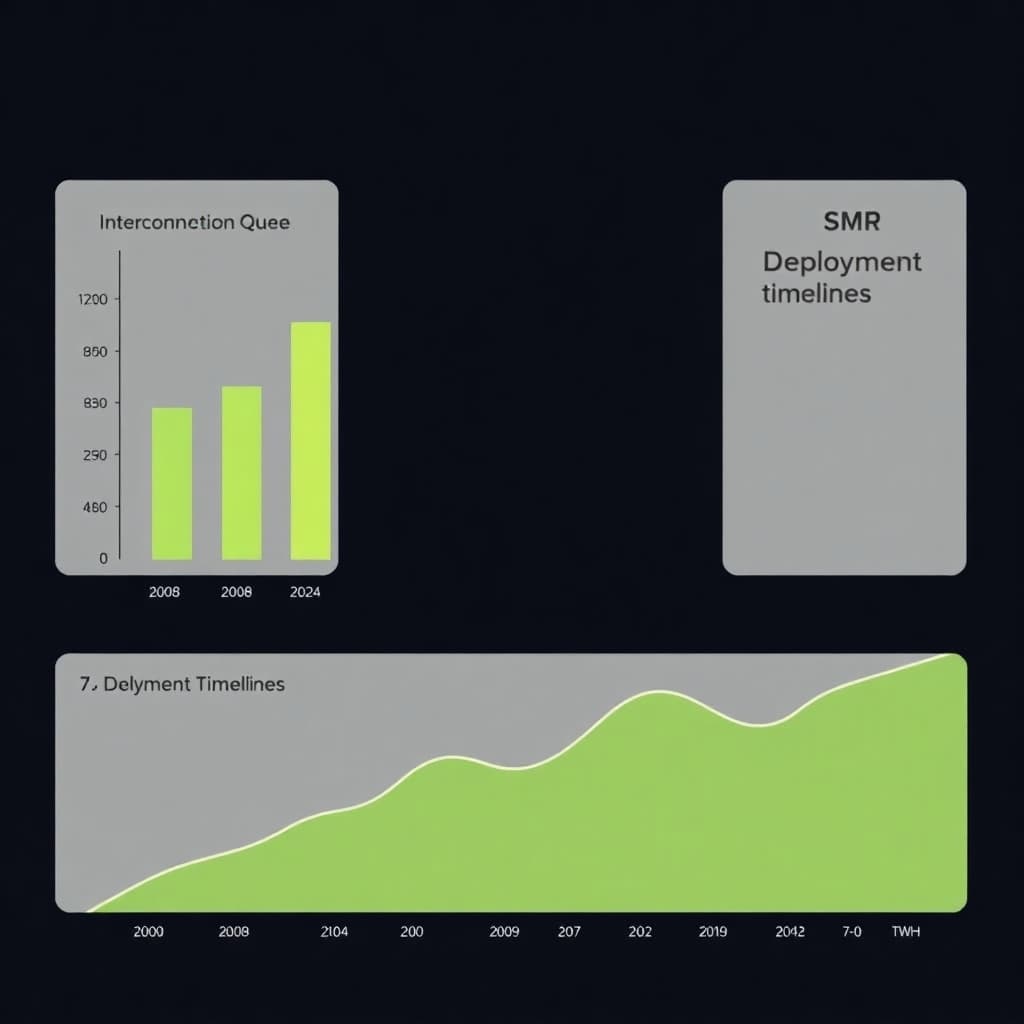
The average wait time for a commercial project to connect to the U.S. transmission grid has surged from less than two years in 2008 to nearly five years today. For a Venture Capitalist evaluating AI infrastructure, this latency is the primary killer of IRR. You can build a gigawatt-scale data center shell in 18 to 24 months, but if that capital sits stranded for three years waiting for a substation energization, the project economics collapse.
This bottleneck has forced a fundamental shift in how hyperscalers (Amazon, Google, Microsoft, Meta) approach energy. The era of buying "green attributes" via Virtual Power Purchase Agreements (V-PPAs) to offset carbon is ending. We are entering the phase of Hyperscale Nuclear Offtake: distinct, physical integration where data centers sit "behind-the-meter" of nuclear assets to guarantee 24/7 baseload power.
This post analyzes the financial restructuring of energy procurement, the pivot to nuclear assets, and the specific risks inherent in funding unproven Small Modular Reactor (SMR) designs.
The Shift from Virtual PPAs to Physical Electron Co-location
For the last decade, "100% renewable" claims were largely accounting exercises. A tech giant would buy solar power in Arizona to "offset" coal-heavy consumption in Virginia. This worked for general cloud compute. It does not work for AI training clusters.
AI workloads require high-density, uninterruptible power. Solar and wind are intermittent; bridging multi-day generation gaps with Lithium-Ion storage at the gigawatt scale is capex-prohibitive. Consequently, hyperscalers are prioritizing carbon-free energy (CFE) matching, where consumption is matched by generation on an hourly basis, not an annual one.
Bypassing the Transmission Congestion
The strategic value of nuclear co-location—like the Amazon Web Services acquisition of the Cumulus data center campus adjacent to Talen Energy’s Susquehanna nuclear plant—is not just the carbon profile. It is the ability to bypass the public utility grid.
By connecting directly to the generation source (behind-the-meter), the data center avoids:
- Transmission & Distribution (T&D) Charges: Often 30-40% of the total industrial electricity rate.
- Interconnection Queues: No need to wait for the regional transmission organization (RTO) to upgrade lines miles away.
- Grid Congestion: Immunity to curtailment events where the grid cannot handle the load.
This creates a bifurcated infrastructure market: "Grid-Tied" assets subject to utility delays, and "Source-Tied" assets that command a significant valuation premium due to immediate power availability.
Economics of the Atom: Structuring the Offtake Deal
The financial structure of these nuclear deals differs radically from standard renewable PPAs. In a solar PPA, the offtaker pays for energy produced. In a nuclear offtake, the hyperscaler is essentially buying an insurance policy on capacity.
The "Firming" Premium
Hyperscalers are accepting electricity prices well above the wholesale market rate to secure firm power. While natural gas might trade at $30–$40/MWh (highly volatile), and solar at $25–$35/MWh (intermittent), new nuclear offtake agreements are striking at $80–$100/MWh or higher (levelized).
Why pay a 200% premium?
- Volatility Hedge: Gas prices spike during geopolitical crises or extreme weather. Nuclear fuel costs are a minor fraction of O&M, making pricing stable for 20+ years.
- CapEx Avoidance: The cost of building a captive 1GW gas plant + carbon capture, or a 4GW solar + storage farm to achieve the same reliability, exceeds the premium paid to the nuclear operator.
The Financing Backstop Model
For new SMRs, hyperscalers are not typically paying for the construction upfront. Instead, they provide the credit wrap. By signing a 15-20 year "take-or-pay" contract before the reactor is built, the hyperscaler guarantees the revenue stream required for the developer (e.g., Oklo, TerraPower) to secure low-cost debt financing.
The SMR Bet: Why Meta and Google Are Funding Unproven Tech
While Amazon bought access to an existing reactor, Google and Meta are betting on future Small Modular Reactors. This is a Venture Capital play disguised as procurement.
The Value Proposition of Natrium and Fast Reactors
TerraPower (backed by Bill Gates) and Oklo (backed by Sam Altman) are moving away from traditional Light Water Reactors (LWR) to designs like sodium-cooled fast reactors.
- Thermodynamic Efficiency: Higher operating temperatures allow for more efficient power conversion and potential industrial heat applications.
- Waste Profiles: Fast reactors can theoretically consume spent fuel from traditional reactors, turning a liability into an asset.
- Passive Safety: These designs rely on physics (expansion of fuel stops the reaction) rather than active mechanical pumping to prevent meltdowns.
However, these are First-of-a-Kind (FOAK) engineering projects. In infrastructure investing, FOAK usually implies cost overruns of 50-100% and timeline delays of years.
Falsifiable Thesis: The Deployment Gap
Claim: No commercial SMR exceeding 50MW capacity will be operational and powering a hyperscale data center in the United States before 2029.
Watch these indicators to confirm or refute:- NRC Part 53 Rulemaking: If the Nuclear Regulatory Commission fails to finalize a streamlined risk-informed licensing framework by mid-2025, the 2029 target is impossible.
- The HALEU Supply Chain: Non-LWR SMRs require High-Assay Low-Enriched Uranium (HALEU). Currently, Russia controls the vast majority of commercial capacity. If Centrus Energy (US) or Urenco (EU) do not announce significant capacity expansions (supply contracts >10 MT/year) by Q4 2025, the fuel will not exist for deployment.
- Oklo's Aurora Powerhouse: Watch the construction permit application status for their Idaho site. Any "Request for Additional Information" (RAI) cycles exceeding 6 months signal a delay into the 2030s.
Grid Defection Risks and the Utility Sector Standoff
The move to go "behind-the-meter" has triggered a defensive reaction from regulated utilities and grid operators.
The Cost-Shifting Argument
When a hyperscaler co-locates with a nuclear plant, they effectively remove that baseload generation from the general grid. However, the nuclear plant was likely financed by ratepayers decades ago. Utilities like AEP and Exelon argue that if data centers siphon off the stable nuclear power, the remaining ratepayers are left with a less reliable grid and higher costs to build new replacement generation.
Regulatory Friction: The FERC Precedent
In late 2024, the Federal Energy Regulatory Commission (FERC) rejected an amended interconnection service agreement (ISA) for the Amazon/Talen Susquehanna deal. This was a critical signal. Regulators are signaling they will not allow "grid defection" that threatens reliability for the broader public without significant exit fees or transmission compensation.
Implication: Future nuclear offtake deals will likely require "Virtual Co-location" where the data center pays for the nuclear power but remains legally connected to the grid, paying transmission fees to subsidize the broader infrastructure. This dilutes the economic advantage of the pure behind-the-meter model.
Conclusion
The hyperscale pivot to nuclear is an acknowledgment that the current grid cannot support the AI revolution. Data centers are reclassifying themselves from commercial real estate tenants to active participants in energy infrastructure development.
For investors, the signal to watch is not the announcement of a partnership, but the approval of a Combined License (COL) for a non-light-water reactor. Until then, these deals are effectively call options on a regulatory and supply chain breakthrough.
FAQ
Q: What is the difference between a PPA and a direct offtake agreement? A: A traditional Power Purchase Agreement (PPA) often involves virtual financial settlements where renewable energy is added to the grid elsewhere to offset usage. Direct offtake, in this context, implies physical delivery or co-location where the data center consumes the electricity generated by the specific plant directly, often bypassing the transmission grid to ensure 24/7 availability.
Q: Why can't hyperscalers rely solely on solar and batteries? A: AI training clusters require constant, high-density power (baseload) with 99.999% uptime. Solar and wind are intermittent, and current battery storage technology is prohibitively expensive to bridge multi-day generation gaps (dunkelflaute events) at the gigawatt scale required by modern data centers.
Sources
- International Energy Agency (IEA) - Electricity 2024 Report
- Lawrence Berkeley National Laboratory - Queued Up: Characteristics of Power Plants Seeking Transmission Interconnection
- U.S. Nuclear Regulatory Commission - Advanced Reactors Status
- Federal Energy Regulatory Commission (FERC) - Order Rejecting ISA Amendment (Susquehanna/Talen)
- World Nuclear Association - Nuclear Power in the USA
Related
View all →
Finance
The 2029 Post-Quantum Mandate: Why Legacy Blockchains Face an Extinction Event
March 29, 2026
...


Finance
The Kinetic-Infrastructure Stagflation Lock: Why the Fed Cannot Hike Through a War Zone
March 08, 2026
...