Finance
The Tokenization of Warfare: How Kinetic Conflict Became a High-Frequency Asset Class
March 01, 2026
...


A 500-basis point interest rate hike cannot intercept a hypersonic missile, nor can it rebuild a bombed desalination plant. This fundamental mismatch between monetary tools and physical reality is the defining economic constraint of 2026.
When the cost of capital for infrastructure projects breaches 8% while the physical assets themselves are being systematically degraded by kinetic warfare, we enter a state of economic paralysis I call the Kinetic-Infrastructure Stagflation Lock.
For fifteen years, quantitative models assumed that supply shocks were logistical—ships waiting at ports or chips missing from assembly lines. These were problems of flow, solvable by time and demand suppression. Today’s shocks are problems of existence. When a drone swarm takes a refinery offline, the capacity is not delayed; it is deleted. The Federal Reserve’s attempt to crush the resulting inflation by raising rates only increases the cost of the capital expenditure (Capex) required to rebuild that capacity, thereby extending the shortage and entrenching the inflation.
The transmission mechanism of this lock is distinct from the wage-price spirals of the 1970s. It operates through a feedback loop where monetary policy inadvertently reinforces physical scarcity.
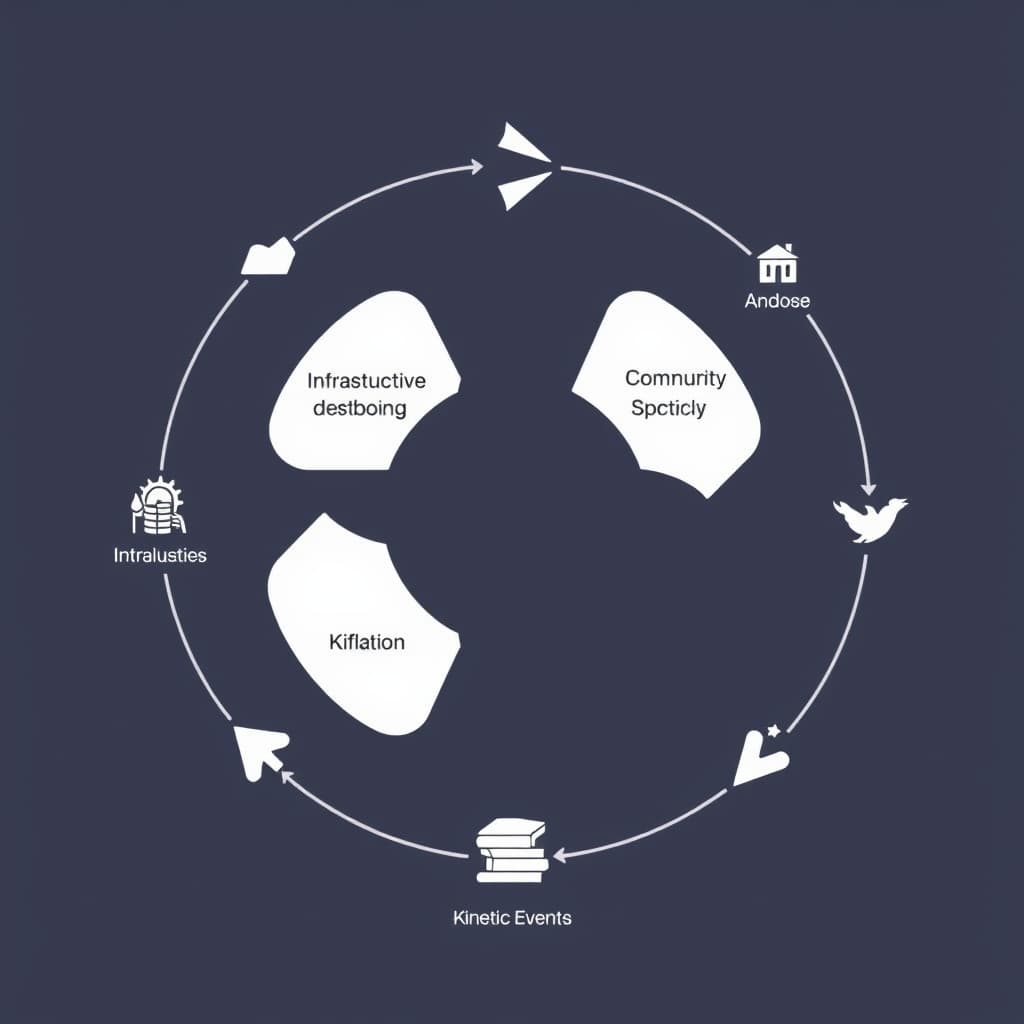
In a standard inflationary cycle, the Fed raises rates to cool demand. Lower demand allows supply to catch up, and prices stabilize. In the Kinetic-Infrastructure Lock, the inflation is driven by a sudden, violent reduction in supply (e.g., a grid attack).
The immediate market reaction is a spike in energy and utility prices. The central bank, adhering to its mandate, tightens policy. However, rebuilding a destroyed power station or hardening a pipeline against attack is capital-intensive. As rates rise, the Internal Rate of Return (IRR) on these reconstruction projects falls below the hurdle rate. Utilities and energy majors delay repairs or cancel expansion plans to preserve cash flow.
The result is a perverse outcome: Tight money prevents the physical reconstruction necessary to lower prices.
Traditional demand destruction works on elastic goods. If televisions become expensive, consumers buy fewer televisions. But the targets of modern kinetic warfare—water, electricity, and fuel—have near-zero demand elasticity.
You cannot interest-rate-hike a population out of needing water. When a targeted strike hits critical infrastructure, consumers do not reduce consumption; they bid up the price of the remaining supply. The Fed is effectively trying to solve a physics problem with a financial calculator.
To understand the severity of this lock, we must look at the current situation in the Persian Gulf, where the theoretical risk has mutated into tangible loss.
The most under-priced risk in global markets is the vulnerability of Middle Eastern desalination capacity. The region relies on centralized plants for potable water. In early 2026, we observed that targeted kinetic disruptive events against two major facilities didn't just cause a humanitarian crisis; they caused an immediate industrial sudden stop.
Cooling systems for petrochemical plants require water. When water capacity is deleted, refining capacity goes offline regardless of oil availability. The subsequent GDP shock was not a "soft patch" but a hard stop.
The Strait of Hormuz has long been a geopolitical anxiety, but the International Energy Agency (IEA) data suggests the impact of a sustained blockage is no longer linear—it is exponential due to the lack of spare tanker capacity.
A 20% reduction in transit volume does not yield a 20% rise in price. In a tight market with degraded infrastructure, it triggers a volatility smile where call options on crude price in a 200-300% premium.
Table 1: Logistical Disruption vs. Kinetic DestructionWe are witnessing the end of the "Don't Fight the Fed" era and the beginning of "Don't Fight the Physics."
Investors often compare today to the 1970s, but the comparison is flawed. The 1973 oil shock was an embargo—a political decision to withhold supply. It could be (and was) reversed by a handshake.
The 2026 shock is defined by degradation. A pipeline that has been blown up cannot be reopened by a treaty. It requires steel, engineering, and, crucially, financing. When the Fed keeps the terminal rate above 5% to fight the headline CPI caused by the explosion, they make the loan to fix the pipeline too expensive to underwrite.
This creates a supply-side liquidity trap. Capital is available for high-velocity trades (AI, software), but capital for hard infrastructure—which has a 20-year payback period—dries up when the risk-free rate is high and the physical risk premium (war) is non-zero. The transmission mechanism of monetary policy is broken because the lever that slows inflation (investment in capacity) is stuck.
Map of Incentives: Who Wins and Loses in the Lock?For fifteen years, the winning strategy was financial engineering: buybacks, leverage, and multiple expansion. In a Kinetic-Infrastructure Lock, the winning strategy is physical resilience.
Allocators must pivot from companies that optimize balance sheets to companies that optimize physical redundancy. We are looking for "anti-fragile" logistics. Does the company have a single point of failure in a conflict zone? If yes, it is a short, regardless of its P/E ratio.
The risk premium for physical assets has structurally shifted upward. Real estate, factories, and data centers located in "safe" jurisdictions (geographically isolated from kinetic zones) will command a massive premium over those in contested regions, creating a bifurcation in asset valuations that standard models miss.
A new sector is emerging: the Defense-Utility Hybrid. These are not pure defense contractors (like Lockheed Martin) nor pure utilities (like Duke Energy). They are firms that specialize in hardened infrastructure—micro-grids, private security for transit, and cyber-kinetic shielding.
Table 2: Asset Class Performance MatrixThe era of managing the global economy through basis points is effectively over. When the primary risk to price stability is a missile strike on a chokepoint, a 25-basis point adjustment is a category error.
Investors must recognize that we are in a regime where fiscal intervention (government-backed guarantees for infrastructure) and defense strategy supersede central bank guidance. The Fed cannot hike through a war zone. Until the physical security of supply chains is re-established—a task for navies, not bankers—inflation will remain structurally higher, and growth structurally lower. The "Lock" will only be broken by concrete and steel, not by credit and sentiment.
Why can't the Federal Reserve lower inflation caused by kinetic warfare? The Fed controls the cost of money, not the physical flow of goods. Raising interest rates reduces consumer demand, but it cannot rebuild a bombed pipeline, reopen a mined shipping lane, or generate electricity from a destroyed plant. When inflation is driven by physical scarcity due to war, monetary policy becomes ineffective because the root cause is supply deletion, not excess demand.
How does the 'Kinetic-Infrastructure Lock' differ from standard supply chain disruptions? Standard disruptions, like those seen during the pandemic, are logistical and temporary (e.g., port congestion). The 'Lock' involves the physical destruction of capacity (plants, grids, ships). This requires years of capital-intensive reconstruction. High interest rates make this reconstruction too expensive, leading to a loop where supply stays low and prices stay high for years.