
Multi-Agent Edge Orchestration: The Death of the Cloud-Only Model
Multi-Agent Edge Orchestration: The Death of the Cloud-Only Model
The prevailing narrative that AI’s future lies exclusively in gigawatt-scale data centers is a financial delusion. While the market remains fixated on NVIDIA’s latest server racks, the real capital efficiency revolution is happening in your pocket. The integration of Perplexity into Samsung’s Galaxy AI ecosystem—announced this week alongside the S26 series—is not merely a partnership; it is the first true signal of the Multi-Agent Edge Orchestration era.
We are witnessing a structural inversion of the compute model. For the past decade, "smart" devices were just dumb terminals for cloud intelligence. That era is over. The new paradigm isn't about running a chatbot on a phone; it's about an on-device orchestration layer that routes intent, manages context, and executes tasks locally, treating the cloud not as a default, but as an expensive fallback.
This post analyzes why the economics of multi-agent systems make the cloud-only model unsustainable and how edge orchestration creates a new hardware supercycle.
Deconstructing the Hybrid AI Architecture
The "Chatbot" is a skeuomorphic relic. The future is an Orchestrator.
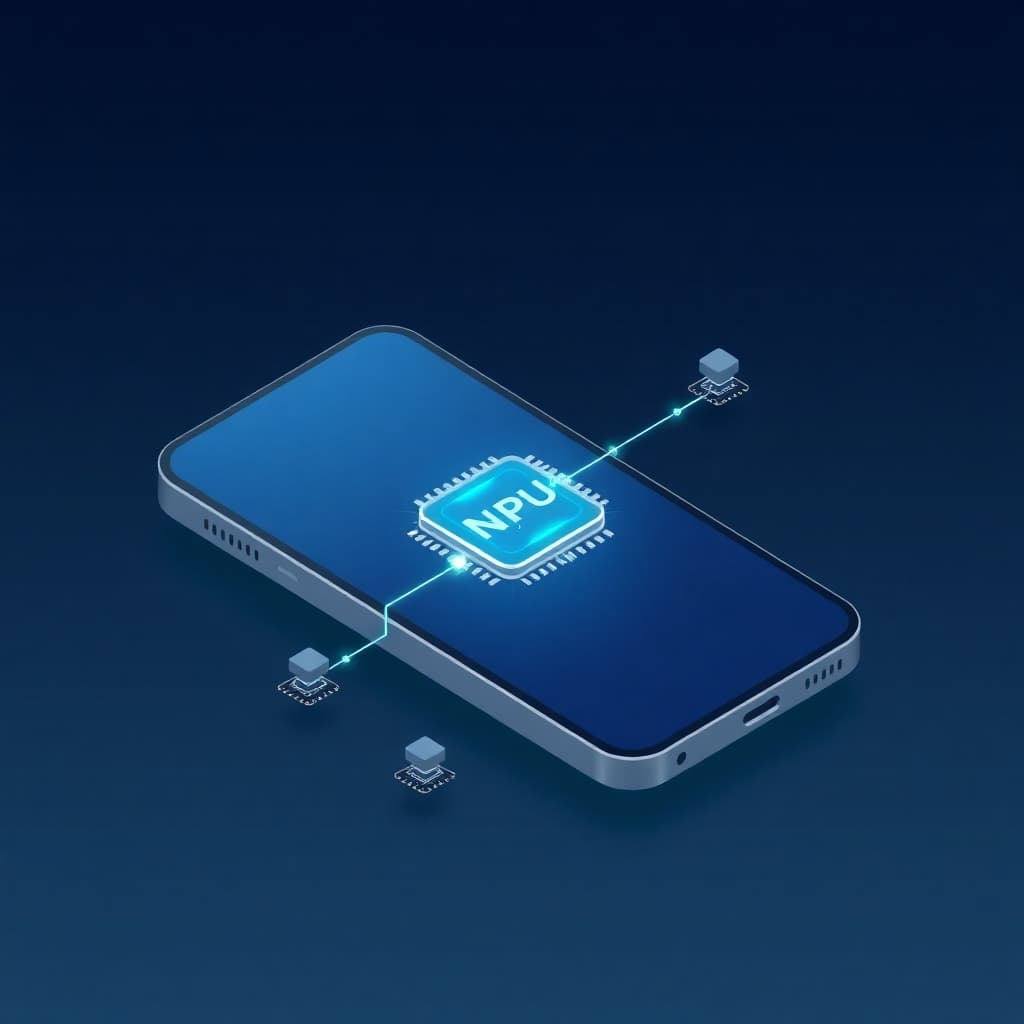
In the cloud-only model, every query—whether "What's the weather?" or "Draft a legal brief"—hits a massive H100 cluster, incurring significant latency and inference costs. Edge Orchestration changes the topology by introducing a local traffic controller, typically residing on the Neural Processing Unit (NPU).
The Role of the NPU as Traffic Cop
The NPU no longer just accelerates matrix multiplication; it acts as a router. When a user engages the device (e.g., via Samsung's "Hey Plex"), the local orchestrator analyzes the complexity of the request.
- Tier 1 (Local): "Reschedule my 2 PM to 4 PM." The NPU routes this to a Small Language Model (SLM) like Gemini Nano or a quantized Llama variant running entirely on-device. Zero latency, zero marginal cost.
- Tier 2 (Hybrid): "Find a restaurant near my next meeting and book a table." The orchestrator parses the calendar locally, then pings a specialized cloud agent (like Perplexity) only for the real-time retrieval, before synthesizing the result locally.
- Tier 3 (Cloud): "Analyze this 50-page PDF." Full cloud offload.
Latency Arbitrage
This architecture introduces "latency arbitrage." By processing the reasoning layer locally, devices reduce the round-trip time (RTT) for multi-step agents. In a cloud-only multi-agent system, Agent A talks to Agent B via API calls over the open internet, compounding latency. On-device, these agents communicate via shared memory buffers, cutting inter-agent latency from hundreds of milliseconds to microseconds.
CapEx Economics: Shifting Compute Costs to the Consumer
The dirty secret of the AI boom is that inference costs (OpEx) scale linearly with user engagement, destroying gross margins for software providers. Multi-agent systems exacerbate this: a single user goal might trigger 15 internal agent-to-agent turns, ballooning token usage.
The Inference Bill Crisis
If Google or OpenAI has to pay for 15 inference steps in the cloud for every user command, their business model collapses. Edge Orchestration solves this by shifting the compute burden from the provider's OpEx to the consumer's CapEx.
When a user buys a $1,200 Galaxy S26, they are pre-paying for the hardware to run their own inference. For the AI provider (Perplexity, Google, etc.), this is the holy grail: Zero Marginal Cost Inference.
The "AI-Capable" Hardware Premium
This shift justifies the ballooning prices of consumer hardware. Manufacturers like Samsung and Apple can protect their hardware margins by marketing the NPU as a "lifetime subscription" to privacy and speed. The chart below illustrates the breakeven dynamics.
Trade-off Analysis: Cloud-Centric vs. Edge-First ExecutionSamsung’s Galaxy AI: A Blueprint for Decentralized Inference
The integration of Perplexity into the Galaxy S26 is a direct assault on the Google Search monopoly, but technically, it’s more significant as a proof-of-concept for the Execution Layer.
Beyond Search: The Execution Layer
Perplexity in this context isn't just a search engine; it's a functional agent with system-level permissions. Unlike a standalone app that is siloed, an orchestrated agent can read the screen, access the file system, and write to the calendar.
This signals the death of the "App" model. In an orchestrated environment, users don't open an airline app to check a flight; the local agent queries the airline's API directly. The interface dissolves. The OS becomes the only app you actually use.
The Android Fragmentation Risk
The challenge here is the Android ecosystem. While Samsung can force vertical integration on its own silicon, the broader Android market relies on a fragmented mess of chipsets. Orchestration requires tight coupling between the OS scheduler and the NPU. If the silicon cannot handle the quantization, the experience falls back to the cloud, negating the economic benefits. This creates a two-tier Android market: "AI-Native" devices (Samsung/Pixel) and "Dumb Terminals" (entry-level OEMs).
The Privacy Premium in On-Device Orchestration
Privacy is no longer just a compliance checkbox; it is a competitive moat.
Regulatory Arbitrage
With the EU AI Act and GDPR tightening the screws on data egress, cloud-centric models face massive compliance overhead. On-device orchestration sidesteps this. If the personal data (health records, financial texts) never leaves the device's secure enclave, the regulatory burden drops significantly.
Trust Architecture
The "Black Box" problem of cloud AI—where you don't know if the model is hallucinating or being manipulated—is mitigated when the orchestration logic is local. Users can verify which agent is being called and what data is being sent. Samsung’s implementation allows users to see exactly when the device hands off a query to Perplexity, creating a verifiable "chain of custody" for their data.
Outlook 2026: The Hardware Supercycle and NPU Wars
As we look through the remainder of 2026, the battleground shifts from who has the best model (OpenAI vs. Anthropic) to who has the best delivery system.
The Memory Wall
The limiting factor for local agents is not compute (TOPS), but memory bandwidth. Running a 7B parameter model alongside the OS requires massive, fast RAM. We are seeing the rapid adoption of LPDDR6 to feed these hungry NPUs. Investors should watch memory manufacturers (SK Hynix, Micron) as closely as the GPU makers.
Battery Density vs. Continuous Inference
"Always-on" agents drain batteries. The next breakthrough must be in power gating—NPUs that can "sleep" and "wake" in microseconds. If the Galaxy S26 cannot last a full day while running local orchestration, the consumer revolt will be swift.
The Silicon Race
Qualcomm and MediaTek are now effectively AI infrastructure companies. The Snapdragon 8 Gen 5 isn't just a mobile processor; it's a server-on-a-chip. The risk here is for proprietary silicon. If Samsung’s Exynos or Google’s Tensor cannot match the NPU efficiency of Qualcomm, they will lose the orchestration war.
What would change my mind? If 6G networks achieve sub-1ms latency and unlimited bandwidth by 2027, the edge advantage diminishes. If connectivity becomes effectively infinite and free, the "dumb terminal" model could return, powered by massive, centralized super-intelligence. Additionally, if model distillation hits a physics wall—meaning we cannot shrink smart models down to phone size without lobotomizing them—the edge orchestration thesis crumbles.
Conclusion: The Value Chain Reset
Multi-agent edge orchestration isn't just a feature; it's a fundamental restructuring of the AI value chain. The value is migrating away from the "Model-as-a-Service" providers who are burning cash on inference, and toward the hardware manufacturers and silicon designers who enable the decentralized execution of these models.
For investors and builders, the alpha is no longer in the chatbot. It is in the silicon, the memory, and the orchestration layer that allows the chatbot to die, replaced by an invisible, ubiquitous intelligence.
FAQ
Q: What is the primary financial advantage of Multi-Agent Edge Orchestration? A: It significantly reduces ongoing cloud inference costs (OpEx) for service providers by offloading processing power to the user's device. This shift allows hardware manufacturers to justify higher upfront prices (CapEx) while software providers achieve better gross margins.
Q: How does the Samsung-Perplexity deal differ from standard Google Search? A: Instead of returning a list of links (blue links) that generate ad revenue, the integration utilizes an answer engine that orchestrates real-time synthesis of information. It acts as an execution layer, prioritizing direct answers and actions (e.g., "book this flight") over traffic redirection.
Q: Why is "Latency Arbitrage" critical for multi-agent systems? A: Multi-agent systems require constant communication between specialized agents. Running this loop in the cloud creates compounding network delays. Running it locally (on the NPU) utilizes shared memory, reducing latency from seconds to microseconds.
Sources
Related
View all →
Finance
The 2029 Post-Quantum Mandate: Why Legacy Blockchains Face an Extinction Event
March 29, 2026
...


Finance
The Kinetic-Infrastructure Stagflation Lock: Why the Fed Cannot Hike Through a War Zone
March 08, 2026
...