

The Tokenization of Warfare: How Kinetic Conflict Became a High-Frequency Asset Class
The Tokenization of Warfare: How Kinetic Conflict Became a High-Frequency Asset Class
If you are still hedging geopolitical risk with quarterly rebalancing of gold and oil futures, you are essentially bringing a knife to a drone fight. The real risk you face today isn't just the kinetic impact of war; it is the latency arbitrage of those who trade the data of that war before the first siren wails. The "fog of war" has cleared, only to be replaced by a high-frequency order book.
We are witnessing a structural break in how violence is priced. Platforms like Polymarket and the algorithmic behavior of Bitcoin during the 2024-2026 conflict cycles have proven that war is no longer an external shock to be weathered—it is a standardized, tradable data feed. This analysis dissects the mechanics of Conflict-Data Commoditization, exposing how geopolitical violence has been transformed from a humanitarian tragedy into a binary option for the institutional and retail speculator alike.
The Architecture of Violence Arbitrage
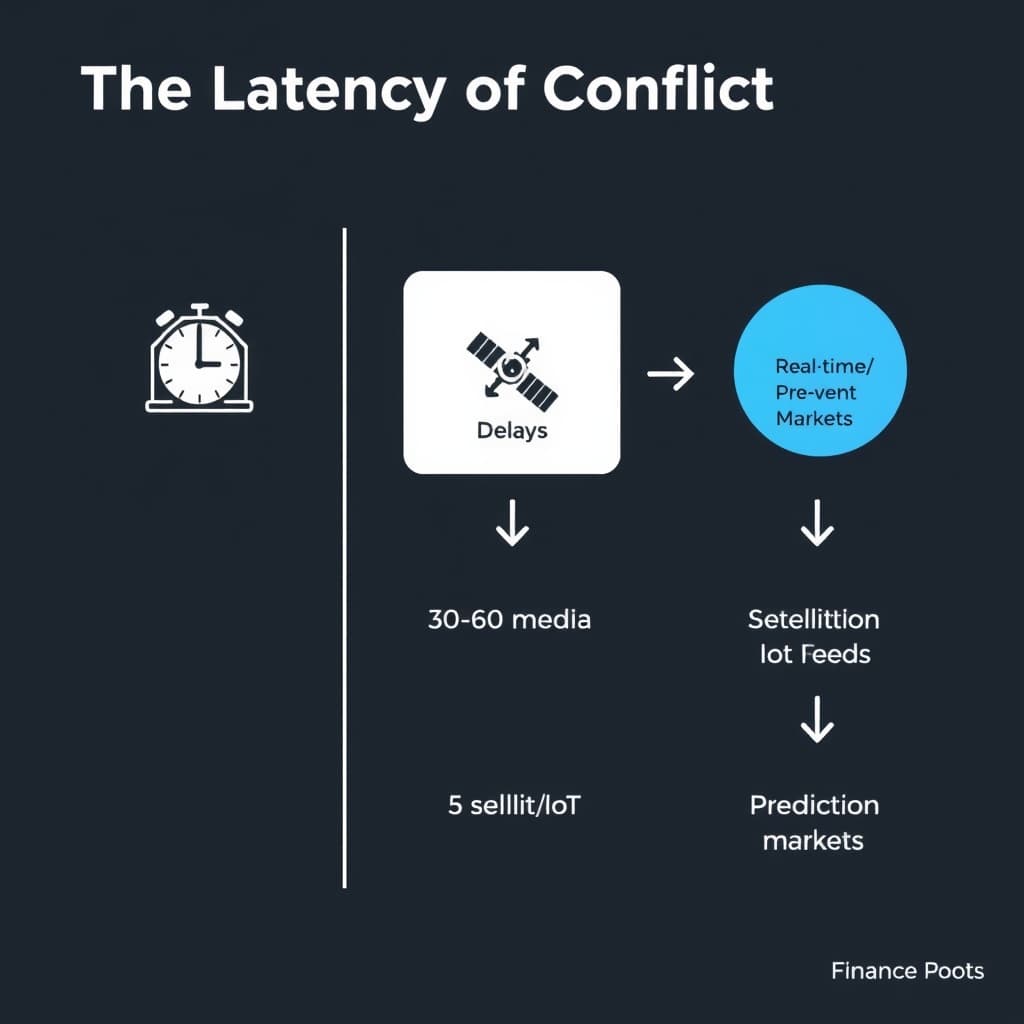
The digitization of the battlefield has inadvertently created the perfect dataset for quantitative finance. Modern warfare generates exhaust data—thermal signatures, transponder signals, and social media metadata—that can be scraped, structured, and fed into execution algorithms faster than a press release can be typed.
From OSINT to Alpha
The alpha is no longer in the analysis; it is in the scraper. During the escalation of hostilities in the Levant throughout 2024 and 2025, we observed a distinct shift in market microstructure. Hedge funds and proprietary trading shops began treating Open Source Intelligence (OSINT) channels on Telegram and X (formerly Twitter) not as news sources, but as direct API inputs.
By utilizing Natural Language Processing (NLP) on localized Telegram channels, algorithms can detect the semantic probability of a missile launch. When a specific density of keywords (e.g., "interception," "siren," "ballistic") appears within a 500-millisecond window, bots execute short positions on risk assets or long positions on volatility indices. This is violence arbitrage: extracting profit from the time delta between a local explosion and global awareness.
Standardizing the Units of Conflict
For violence to be traded efficiently, it must be standardized. You cannot trade "tension." You can, however, trade a binary contract: "Will Israel conduct a confirmed airstrike on Isfahan by March 5, 2026?"
This requires a rigorous definition of settlement criteria, effectively gamifying the Rules of Engagement. The data provider (the Oracle) becomes the judge and jury. If a strike occurs but is denied by state media, does the contract pay out? The resolution criteria for these contracts have become as complex as ISDA master agreements. We are seeing the emergence of "Conflict-Data Standards," where the definitions of war are written not by the Geneva Convention, but by the settlement layers of decentralized betting protocols.
Prediction Markets as Decentralized Intelligence Agencies
The intelligence community has long suffered from bureaucratic latency. Prediction markets, by contrast, operate on the ruthless efficiency of greed. When liquidity is the incentive, the market often discovers the truth faster than the CIA.
Liquidity as Truth
In late 2024, Polymarket volumes surged on contracts related to Middle Eastern escalation. While diplomats issued vague statements about "de-escalation," the order books told a different story. Heavy buy-side volume on "Yes" contracts for specific strike vectors effectively front-ran official state narratives.
This phenomenon challenges the Efficient Market Hypothesis. In this domain, the market isn't just reflecting all available information; it is incentivizing the leakage of private information. If a military insider knows a strike is imminent, the most profitable action is not to leak it to a journalist, but to max out a position on a decentralized prediction market where KYC (Know Your Customer) protocols are porous or nonexistent.
The Polymarket Paradigm
Polymarket and its offshore competitors have defended these contracts as "invaluable" forecasting tools. They argue that putting a price on the probability of war helps NGOs and governments prepare. There is a grain of truth here—price signals are powerful. However, this defense masks the reality that these platforms have turned the theater of war into a casino. The "utility" is secondary to the volume. The market structure demands volatility; peace is low-volume, low-fee. War is high-volume, high-fee. The incentives of the platform are structurally aligned with conflict continuation, or at least, conflict uncertainty.
Bitcoin’s Pivot from Digital Gold to Conflict Beta
The narrative that Bitcoin is "digital gold"—a non-correlated safe haven—died in the trenches of 2025. What emerged in its place is Bitcoin as a high-beta liquidity valve for geopolitical stress.
Analyzing the 2024-2026 Strike Vectors
Quantitative analysis of price action during the Iranian strike windows of April and October 2024, and subsequent flares in 2025, reveals a consistent pattern. Unlike Gold, which grinds higher on uncertainty, Bitcoin reacts with immediate, violent downside volatility followed by a sharp mean reversion.
The Decoupling Mechanism
Why does crypto dump when missiles fly? Because it is the only asset class that is liquid, tradeable, and open 24/7. When a fund manager needs to de-risk a portfolio at 3:00 AM on a Sunday because a geopolitical event has occurred, they cannot sell Apple stock. They can, however, dump Bitcoin.
Thus, Bitcoin has not become a hedge against war; it has become the canary in the coal mine for war. It is the first asset to price in the kinetic energy of a conflict, serving as a leading indicator for traditional markets that are still sleeping.
Regulatory Firewalls and the Ethics of 'Blood Money'
The commoditization of conflict data inevitably runs headfirst into the brick wall of regulation. The U.S. Commodity Futures Trading Commission (CFTC) has drawn a line in the sand, but the tide of decentralization is washing it away.
CFTC Scrutiny on Event Contracts
The CFTC has explicitly targeted event contracts involving terrorism, assassination, and war gaming, citing Regulation 40.11 which prohibits contracts contrary to the public interest. The regulator’s stance is clear: you cannot wager on death.
However, the definition of "wager" is being litigated. If a logistics company buys a contract paying out in the event of a Suez Canal blockade (caused by military action) to hedge their shipping costs, is that gambling or risk management? The line between a prediction market and an insurance derivative is blurring. By 2026, we are seeing the rise of "Geopolitical Swaps"—institutional-grade products that strip out the "gambling" optics but retain the underlying mechanic of pricing violent outcomes.
The 2026-2030 Outlook
We are moving toward a bifurcated world. Onshore, regulated entities will trade sanitized "Geopolitical Risk Indices" approved by the SEC and CFTC. Offshore, on decentralized ledgers, the raw, unfiltered "Assassination Markets" will thrive. The ethical dilemma is profound: does allowing people to profit from war encourage them to foment it? Or does it simply force us to look at the ugly, priced-in reality of our world?
Map of Incentives
- The Winners: High-Frequency Trading (HFT) firms with superior satellite/social scrapers; Offshore prediction platforms collecting trading fees; Insiders with advanced knowledge of military maneuvers.
- The Losers: Retail traders reacting to delayed cable news; Regulators fighting code with subpoenas; The victims of conflict whose suffering is reduced to a ticker symbol.
- The Incentive: Speed. The market rewards the fastest confirmation of violence, incentivizing a surveillance apparatus that leaves no corner of the globe unmonitored.
What Would Change My Mind
I would reassess this thesis if we see a successful, coordinated global crackdown on the "Oracle" layer—the data feeds that settle these bets. If governments can effectively sanction or shut down the decentralized oracles (like Chainlink or UMA) that verify real-world outcomes, the market structure collapses. Alternatively, if Generative AI floods the information space with so many convincing "deepfake" war clips that the prediction markets lose confidence in their ability to resolve truth, liquidity could evaporate, forcing a return to traditional, slower hedging assets.
Conclusion
Geopolitical violence is no longer an external market shock; it is an internal pricing variable. We have successfully financialized the fog of war. For the investor, the lesson is stark: relying on moral outrage or traditional safe havens is a losing strategy. In a digitized war economy, information supremacy—specifically the speed at which you can process conflict data—is the only true hedge.
FAQ
Is betting on war outcomes legal in the United States? Generally, no. The CFTC prohibits event contracts that involve terrorism, assassination, or war (gaming) under the belief they are contrary to the public interest. However, offshore decentralized platforms often bypass these restrictions, and U.S. users frequently access them via VPNs, despite the legal risks.
How does conflict data differ from traditional geopolitical risk analysis? Traditional analysis relies on qualitative reports, historical context, and long-term forecasts (days/weeks). Conflict data commoditization involves high-frequency, quantitative inputs—such as satellite thermal signatures or social media scrape velocity—that trigger immediate algorithmic buy/sell orders in milliseconds.
Sources
Related
View all →
Finance
The 2029 Post-Quantum Mandate: Why Legacy Blockchains Face an Extinction Event
March 29, 2026
...



Finance
The Kinetic-Infrastructure Stagflation Lock: Why the Fed Cannot Hike Through a War Zone
March 08, 2026
...