


Civic Feedback Decoupling: The End of Data-Driven Political Legitimacy
For investors and strategists, the sudden disappearance of a reliable macro-indicator is usually a precursor to volatility. When Gallup announced it would cease its daily tracking of presidential approval ratings—a metric that has served as the heartbeat of American political legitimacy for nearly a century—it signaled more than a change in methodology. It marked the formal beginning of Civic Feedback Decoupling.
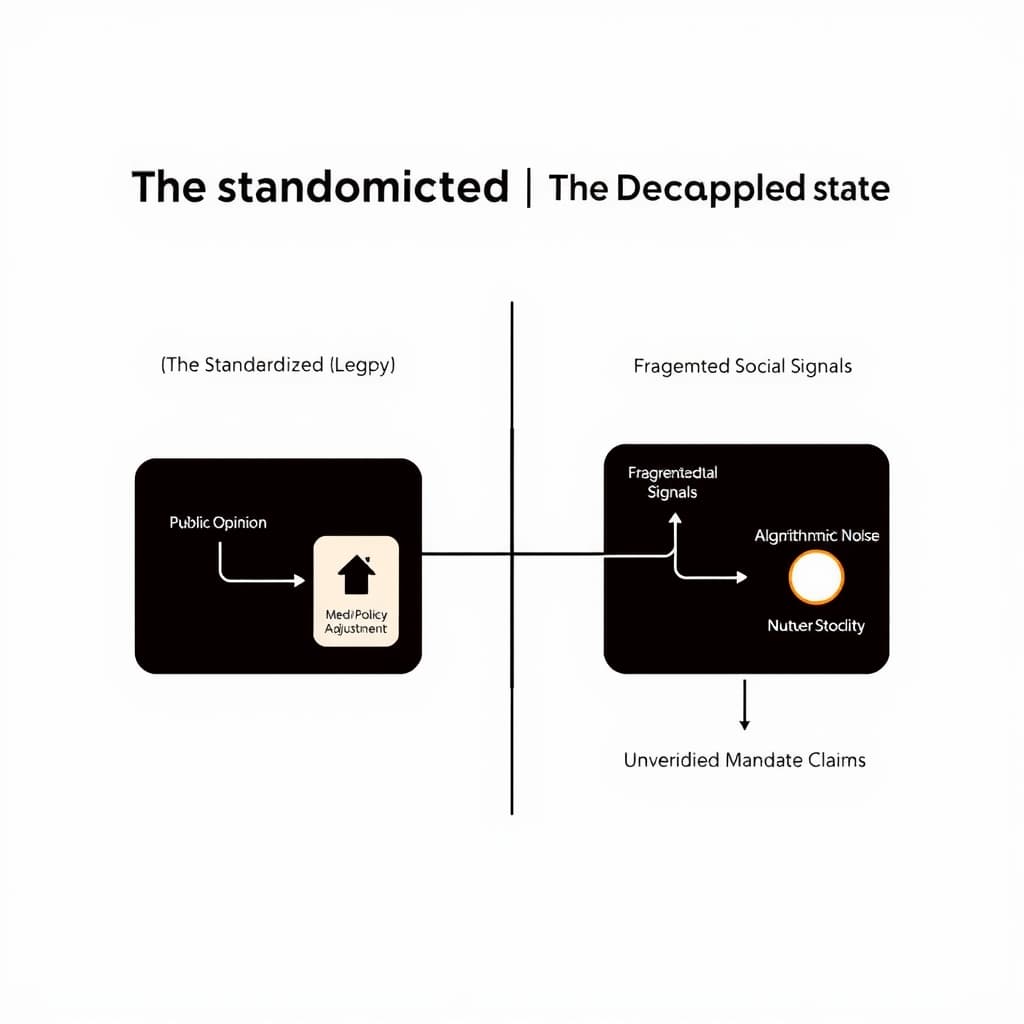
We are entering a period where the mandate to govern is no longer tethered to standardized, public data streams. For decades, the "approval rating" served as a widely accepted, albeit imperfect, clearing price for political capital. Without it, we face a fragmented reality where legitimacy is claimed rather than proven, and consensus is simulated rather than measured. This analysis explores the structural dismantling of the feedback loop between the governed and the governing, and why current technology stacks are failing to fill the void.
The Death of the Daily Tracker: Why High-Frequency Polling Became Obsolete
The retreat of major polling institutions from daily tracking is a rational response to a broken business model. The Return on Investment (ROI) for traditional phone-based polling has collapsed, rendering the data it produces statistically insignificant for real-time decision-making.
The Economics of Non-Response
In the mid-20th century, response rates for telephone polls hovered near 80%. Today, reputable firms struggle to achieve response rates above 1%. This creates a massive "non-response bias" that requires increasingly aggressive statistical weighting to correct.
For a data scientist, this is the equivalent of training a model on 99% synthetic data and 1% ground truth. The cost to acquire a single, verified respondent has skyrocketed, making high-frequency tracking financially unsustainable. The "Daily Tracker" was not killed by a lack of interest; it was killed by the inefficiency of the analog capture mechanism.
Statistical Model Collapse
The breakdown extends beyond cost. The demographic weighting models used to extrapolate the "national mood" from small samples rely on the assumption that the non-respondents behave similarly to the respondents. This core assumption has fractured.
We now see a bifurcation in civic behavior: those willing to engage with institutional data collectors (pollsters) often possess fundamentally different psychographic profiles than those who refuse. No amount of algorithmic weighting can accurately correct for a population segment that systematically opts out of the measurement infrastructure.
The Legitimacy Void: Governing Without the Numbers
Case Analysis: The Rise of Narrative-Based Legitimacy
When the dashboard goes dark, navigation shifts from instrument-rated to visual flight rules. In the political sphere, the absence of a universally accepted "score" allows administrations to substitute data with narrative.
From Metrics to Vibes
Consider the shift in how political capital is deployed. In a high-data environment, a leader with a 35% approval rating is mathematically constrained; their leverage to push controversial legislation is capped by the public record of their unpopularity.
In a Civic Feedback Decoupled environment, that constraint vanishes. Without a single, trusted number to refute them, leaders can claim a "silent majority" mandate based on siloed metrics—such as rally attendance, social media engagement, or small-dollar donation velocity.
We are witnessing a transition from Empirical Legitimacy (proven by broad data) to Narrative Legitimacy (asserted by localized signals). This explains the increasing disconnect between policy implementation and traditional sentiment indicators. A governing body no longer needs to wait for the "polling bounce" to act because the mechanism for measuring that bounce is disputed or non-existent.
The Prediction Market Pivot
As traditional polling fades, capital and attention have shifted toward prediction markets like Polymarket or Kalshi. These platforms offer a different value proposition: they measure conviction (money risked) rather than sentiment (opinion stated).
While efficient for binary outcomes (Win/Loss), these markets fail as governance feedback loops. A prediction market can tell you if a policy will pass, but it cannot tell you if the citizenry believes the policy is just. The decoupling persists because liquidity is not a proxy for democratic consent.
Fragmented Reality: The Privatization of Consensus
The vacuum left by public polling is being filled by private, proprietary surveillance. The concept of a "National Number" is being replaced by thousands of algorithmic micro-realities.
Proprietary Sentiment Silos
Political campaigns and corporate lobbyists have not stopped collecting data; they have simply stopped sharing it. We have moved from a "Public Utility" model of polling (Gallup, Pew) to a "Hedge Fund" model (Cambridge Analytica successors, internal party analytics).
- Public Data: Broad, shallow, standardized, transparent.
- Private Data: Granular, psychographic, siloed, opaque.
This privatization means that the "will of the people" is now trade secret intellectual property. A venture firm analyzing regulatory risk can no longer look at a public approval chart to gauge stability. They must instead rely on fragmented social listening tools that are highly susceptible to bot manipulation and algorithmic amplification.
The Impossibility of Consensus
Decentralized social graphs make creating a single national metric impossible. An approval rating derived from X (formerly Twitter) looks radically different from one derived from TikTok or Facebook. Because these platforms segregate users into resonance chambers, there is no shared baseline reality to measure against.
Future Architectures: Can Decentralized Identity Restore the Loop?
If the telephone is dead as a verification tool, the only viable successor is cryptographic proof. However, the gap between potential and implementation remains vast.
Evaluating Blockchain and SSI
Self-Sovereign Identity (SSI) and Zero-Knowledge Proofs (ZKPs) offer a technical solution to the polling crisis. Theoretically, a citizen could prove they are a unique, eligible constituent and cast a sentiment "vote" without revealing their identity to the pollster.
This would solve the two biggest problems of the current era:
- Verification: Proving the respondent is a real human (not a bot).
- Privacy: Eliminating the fear of social retribution for honest answers.
The Implementation Trade-Off
Despite the promise, the friction of adoption prevents this from scaling before 2028. The current user experience (UX) of managing private keys or verified credentials is too complex for mass adoption.
Decision Matrix: Selecting a Sentiment Feedback MechanismThe 2026-2030 Outlook
We anticipate a "Wild West" period for the next 3-5 years. Until a user-friendly, privacy-preserving identity layer (likely integrated into mobile OS wallets) achieves 60%+ penetration, we will operate without reliable civic feedback.
During this interim, political volatility will increase. Administrations will miscalculate public tolerance for policies because they are reading noise as signal. For the private sector, this means regulatory risk is no longer priced in by public sentiment—it must be hedged actively.
The Era of Cryptographic Truth
The era of the single approval number is over. We cannot reverse the technological shifts that destroyed the telephone poll. As we move forward, the challenge isn't just counting votes or opinions; it is establishing a new, verifiable protocol for public consensus.
For the next decade, legitimacy will not be derived from a percentage point on a graph. It will be contested in the gap between proprietary data and public narrative. The organizations that survive this decoupling will be those that stop looking for a "national approval rating" and start building their own verified, direct channels of feedback with their stakeholders.
FAQ
What exactly is Civic Feedback Decoupling? It refers to the breaking of the traditional link between public sentiment data (like standardized polls) and political legitimacy. This results in governance that operates without continuous, standardized performance metrics, forcing leaders to rely on fragmented or unverified data.
How will political consensus be measured without Gallup's tracking? Consensus measurement is fragmenting into three unreliable streams: private sector social listening tools (prone to bot noise), election-only data points (too infrequent), and partisan internal polling (biased). This leads to a lack of a shared, objective reality.
Sources
Related
View all →