

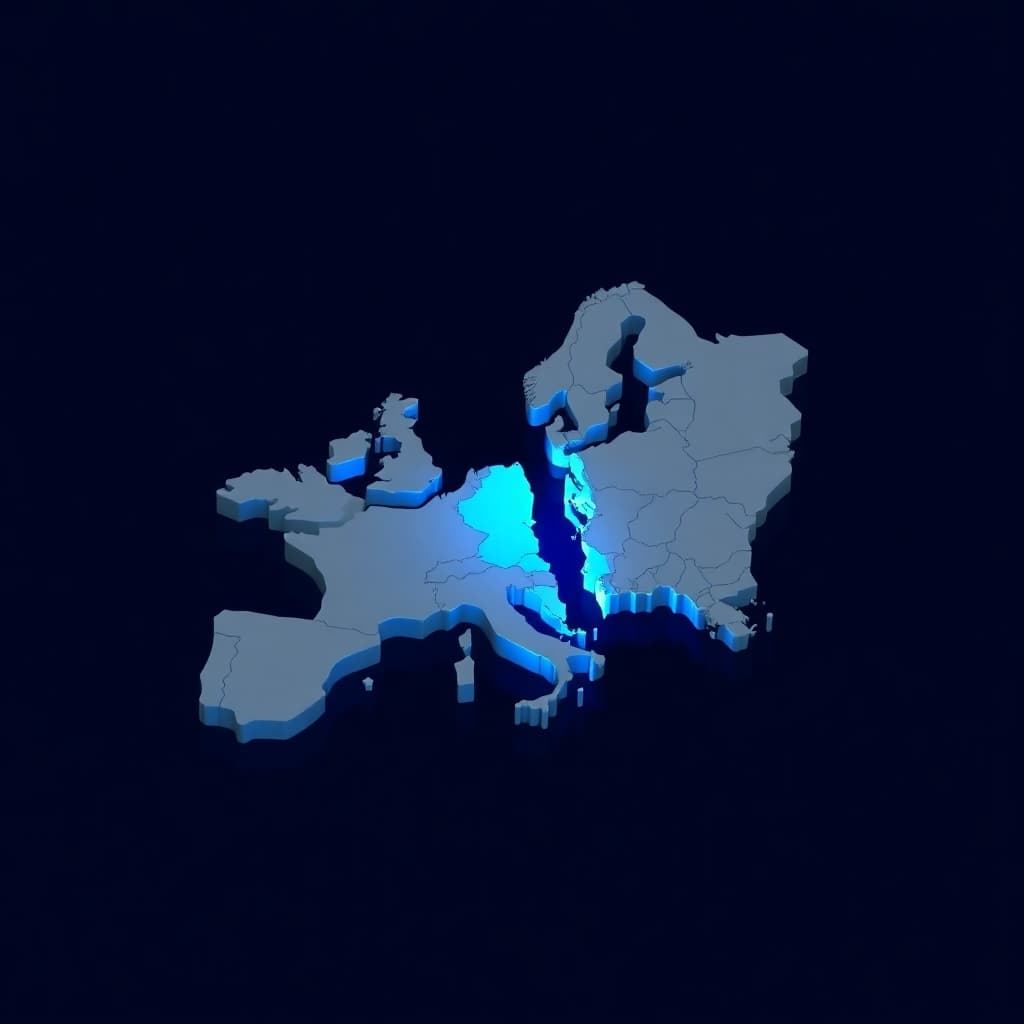
Fortress Europa: The Trillion-Euro Split From US Defense Tech
When the European Space Agency (ESA) explicitly prioritized the costlier, delayed Ariane 6 launch vehicle over SpaceX’s proven Falcon 9 for its sensitive reconnaissance payloads, the market received a clear, albeit expensive, signal. This was not an economic decision; it was a declaration of industrial independence. The era of the guaranteed American security umbrella has formally ended, and with it, the assumption that US defense primes hold a permanent claim on European procurement budgets.
We are witnessing Post-Hegemonic Defense Decoupling. As Washington pivots inward, London and Paris are orchestrating a rapid industrial divergence to secure strategic autonomy. For venture capital and institutional investors, this is the single most significant capital reallocation event of the decade. The transatlantic bridge remains, but the toll booth is closing, and the flow of capital is being rerouted into a sovereign European architecture that explicitly excludes the traditional US "black box."
The Starmer-Macron Pact: Architecting the Post-American Security Grid
The recent diplomatic intensification between Downing Street and the Élysée Palace is not merely a reaffirmation of the Entente Cordiale; it is a structural hedge against White House volatility. The "isolationist hedge" has moved from theoretical think-tank papers to hard procurement law.
Codifying the Isolationist Hedge
European leaders are structurally bypassing Washington’s political oscillation. The renewed Lancaster House treaties and subsequent EU-UK defense accords are designed to create a hermetically sealed industrial base. The goal is to ensure that a sudden shift in US foreign policy—or a hold on export licenses—cannot ground the Royal Air Force or the Armée de l'Air.
This creates a distinct "Buy European" premium. We are seeing procurement tenders that now weight "sovereign control of IP" higher than "unit cost." For US investors, this means the days of selling off-the-shelf F-35s with no technology transfer are numbered. The new standard demands full source-code access, something US ITAR (International Traffic in Arms Regulations) restrictions rarely permit.
The Legal Pivot: Excluding Non-European Vendors
Brussels is rewriting the rulebook on critical infrastructure. New directives regarding the European Defence Fund (EDF) are increasingly exclusionary. To qualify for the most lucrative grants, consortia must demonstrate that their supply chains are free from "third-country control mechanisms." In plain English, if the US State Department can veto the export of a component, that component is becoming a liability for European integrators.
Silicon Sovereignty: Rebuilding the Military-Industrial Stack
The decoupling is most aggressive in the digital domain. Hardware is visible, but software is the kill chain. Europe’s reliance on US tech giants for cloud computing and GPS has been identified as a critical vulnerability.
Severing the Digital Tether
The push for "Sovereign Clouds"—infrastructure physically located in Europe and immune to the US CLOUD Act—is accelerating. Defense ministries are mandating that sensitive data never touches a server owned by a US hyperscaler (AWS, Azure) without massive encryption layers controlled by European entities like Orange or Deutsche Telekom.
Simultaneously, the reliance on GPS is being phased out for military-grade targeting. The Galileo Public Regulated Service (PRS) provides an encrypted navigation signal independent of the US Air Force’s GPS constellation. This ensures that European missiles find their targets even if the US degrades GPS accuracy during a geopolitical dispute.
The Rise of 'Euro-First' Procurement
We are tracking a surge in capital flowing toward European startups building "ITAR-free" components. From drone swarms to ballistic guidance software, the mandate is clear: build it here.
- Case in Point: The rapid valuation growth of companies like Hensoldt (sensor solutions) reflects the market's appetite for indigenous electronics that do not require a license from Washington to be exported to third parties.
Financing the Fortress: The Era of War Bonds and Deficit Hawks
Ideology without liquidity is hallucination. The most startling shift in this decoupling is the abandonment of fiscal austerity in favor of military Keynesianism.
Breaking the Austerity Taboo
Defense spending is forcing a rewrite of the Maastricht criteria. The 3% deficit limit is being effectively bracketed for defense expenditures. Germany’s Zeitenwende fund was just the precursor; we are now seeing the framework for joint EU defense bonds. This effectively ring-fences capital for the domestic military-industrial complex, creating a guaranteed revenue stream for European primes that is decoupled from general economic performance.
Market Impact: The Transatlantic Divergence
Investors must note the decoupling of equity performance. While US primes trade on global stability and US budgets, European defense equities (Rheinmetall, BAE Systems, Thales) are trading on a "rearmament supercycle." The correlation between the S&P Aerospace & Defense Select Industry Index and the STOXX Europe 600 Industrial Goods & Services is weakening. Capital is rotating into European firms that have order books guaranteed by 5-10 year sovereign rearmament plans.
The 2030 Fragmentation: Two Distinct Western Markets
By 2030, we will not see a unified NATO market, but two interoperable yet distinct industrial spheres.
Interoperability vs. Independence
The technical risk is significant. As Europe develops its own combat cloud (FCAS) and the UK/Italy/Japan pursue theirs (GCAP), the seamless data sharing that defined NATO operations is threatened. Cybersecurity standards are diverging. A European tank running on a sovereign OS may struggle to interface with a US drone swarm if the data protocols are not harmonized. This creates a massive opportunity for "middleware" startups—companies that specialize in translating between the US and Euro-stacks without violating sovereignty requirements.
Europe as a 'Third Pole' Exporter
Perhaps the most threatening development for US contractors is Europe’s emergence as a "Third Pole" competitor. By stripping US components out of their systems, European manufacturers can sell weapons to the Global South (India, Brazil, Saudi Arabia) without needing Washington’s permission. The Rafale’s export success was the proof of concept; the next generation of European hardware is being designed explicitly for export unencumbered by US foreign policy whims.
Strategic Decision Matrix: The Sovereign Premium
For allocators, the choice between US and European defense exposure now involves distinct risk profiles.
The transatlantic bridge isn't burning, but the traffic patterns have permanently changed. Investors must recognize that the next decade of defense spending will be strictly compartmentalized, favoring regional champions over global integrators. The alpha lies in identifying the European deep-tech firms that solve the "sovereignty gap"—the specific technologies that allow Brussels to say "No" to Washington.
FAQ
What does 'defense decoupling' mean for US tech companies? It signals a gradual but structural loss of market share for US defense contractors and cloud providers (like Microsoft or AWS) in Europe. As EU governments mandate "sovereign" solutions free from the US CLOUD Act and ITAR restrictions, US firms will be relegated to non-critical layers of the stack or forced into joint ventures where they hold minority stakes.
How will Europe fund this massive military buildup? Expect a combination of reallocated social spending, the issuance of joint EU defense bonds, and potentially higher taxes on digital services. The political will now exists to treat defense spending as "investment" rather than "expenditure," effectively exempting it from traditional fiscal deficit rules.
Sources
- European Defence Agency - Coordinated Annual Review on Defence (CARD)
- European Commission - European Defence Fund (EDF) Regulations
- NATO - Defence Expenditure of NATO Countries (2014-2024)
- UK Government - The Lancaster House Treaties: 10 Year Review
- Thales Group - Sovereign Cloud & Cybersecurity Strategy
Related
View all →