

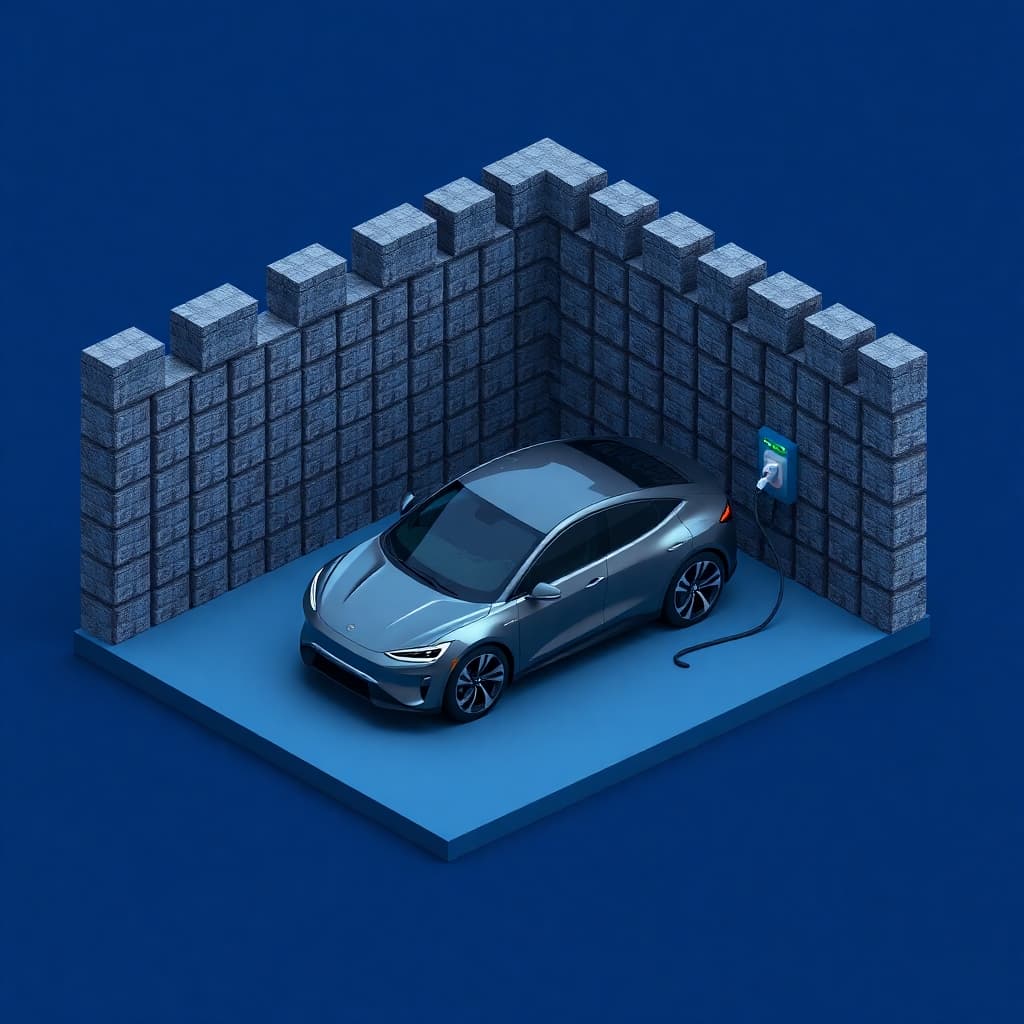
Fortress Europe: How 70% Local Content Rules Are Weaponizing EV Subsidies
The era of open global trade for green technology is effectively over. Automotive executives and supply chain strategists must now navigate a landscape where tariffs act merely as a defensive wall, while the European Union’s latest policy shift introduces a far more aggressive offensive mechanism: Domestic-Content Subsidy Gating.
By proposing a strict 70% local value-add requirement for Electric Vehicles (EVs) to access state incentives, Brussels is sending a clear signal: access to European capital now requires European manufacturing roots. This is not a simple tax on imports; it is a fundamental restructuring of the market that threatens to render non-compliant OEMs commercially obsolete, regardless of their technological superiority or cost efficiency. This analysis examines the mechanics of this policy and why it poses a greater existential threat to foreign OEMs than simple border taxes.
The Mechanics of the 70% Threshold: Redefining 'Made in Europe'
The genius—and the danger—of the 70% rule lies in its redefinition of origin. Historically, "Made in Europe" could be stamped on a vehicle if the final assembly and a modest percentage of parts occurred within the bloc. The new proposal moves the goalposts entirely, shifting focus from final assembly to the deep-tier supply chain.
Moving the Goalposts from Assembly to Component Origin
Under previous regimes, a manufacturer could import a "semi-knocked-down" (SKD) kit—essentially a nearly finished car—and perform final assembly in a localized facility to qualify as domestic. The new framework dismantles this "screwdriver factory" loophole.
Regulators are now scrutinizing the origin of value, not just the location of labor. If the intellectual property, the high-value electronics, and the raw material processing occur outside the European Economic Area (EEA), the vehicle fails the test. This creates a binary outcome for subsidies: you either meet the 70% threshold and access the €4,000–€7,000 price advantage (depending on the member state), or you are effectively priced out of the volume market.
Calculating Value-Add: The Battery Bottleneck
The mathematical reality of an EV makes the 70% threshold particularly brutal. The battery pack alone accounts for 30% to 40% of a vehicle's total value.
If an OEM imports the battery cell from China or South Korea, hitting a 70% local value-add target becomes mathematically impossible, even if every other component is sourced from Germany or France. This turns battery cell production into the single most critical compliance bottleneck. The policy effectively mandates that to sell cars in Europe, you must build gigafactories in Europe.
The Compliance Chasm: Asian Battery Giants and the Localization Race
To understand the severity of this shift, we must look at how the market leaders are reacting. The response is not to lobby for lower thresholds, but to aggressively colonize the European industrial base.
CATL and BYD: Inside the Fortress
Chinese manufacturers, anticipating this regulatory wall, have moved faster than European legacy automakers. CATL’s massive investment in Debrecen, Hungary, is not just about capacity; it is a compliance play. By localizing cell production within the EU, CATL effectively sells "subsidy eligibility" to its clients (BMW, Mercedes, etc.).
Similarly, BYD’s decision to build a passenger car factory in Hungary is a direct counter-maneuver to subsidy gating. By localizing the entire vertical stack inside the EU, BYD neutralizes the policy threat, transforming from a "foreign importer" to a "local manufacturer" in the eyes of the regulator.
The Tesla Berlin Dilemma
Tesla provides a contrasting case study in supply chain depth. While the Berlin-Brandenburg Gigafactory produces the Model Y, the supply chain for its battery cells has historically fluctuated between imports and local assembly.
If the 70% rule is enforced strictly, Tesla faces a precarious situation. If they rely on imported cells (even from their own global network) or if the cathode active material (CAM) is sourced from non-compliant jurisdictions, their "German-made" cars could still be disqualified from incentives. This forces Tesla to accelerate the ramp-up of its 4680 cell production onsite in Berlin, a process that has been technically challenging and capital intensive.
Weaponizing Capital: Why Tariffs Were No Longer Sufficient
Tariffs are a blunt instrument. A 10% or even 20% tariff can often be absorbed by efficient manufacturers who simply compress their margins to maintain market share. Subsidies, however, act as a market multiplier.
Closing the Price Parity Gap
The EU recognized that Chinese OEMs have a cost advantage of roughly 25-30% over European rivals. A 20% tariff barely levels the playing field. However, "Subsidy Gating" acts as a double penalty.
Consider a €30,000 vehicle.
- The Import: Pays a tariff (raising cost) + receives zero subsidy. Price to consumer: ~€35,000.
- The Local: Pays no tariff + receives €5,000 subsidy. Price to consumer: ~€25,000.
The policy creates a €10,000 price delta on a €30,000 asset. No amount of manufacturing efficiency can overcome a 33% artificial price disadvantage. This forces foreign capital to commit to European CAPEX or abandon the mass market entirely.
Leveraging State-Backed Incentives
This mechanism allows the EU to direct foreign direct investment (FDI) without technically violating free trade agreements as blatantly as an outright ban would. By framing the rule as "eligibility for state funds" rather than "market access," Brussels creates a "pay-to-play" environment. The entry fee is building a factory.
Global Fragmentation: The Economic Cost of Duplicate Supply Chains
The pursuit of industrial sovereignty comes with a heavy price tag. We are witnessing the intentional fragmentation of the global automotive market.
Conflicts with WTO TRIMs
This policy likely violates the World Trade Organization’s Agreement on Trade-Related Investment Measures (TRIMs), which prohibits linking subsidies to local content requirements. However, the WTO’s dispute settlement mechanism is currently paralyzed. The EU is calculating that by the time any legal challenge is resolved, the factories will already be built.
Inflationary Pressures on Consumers
The immediate losers are European consumers. By effectively banning low-cost imports from the subsidy pool, the EU removes the deflationary pressure that Chinese EVs placed on the market. European legacy automakers, shielded from price competition, have less incentive to lower prices. The result is a "greenflation" scenario where EVs remain a luxury product for longer, potentially slowing the overall transition to net-zero.
Map of Incentives: Winners and Losers
-
WINNERS:
- EU Construction & Industrial Firms: Billions in factory CAPEX must be spent locally.
- Tier 1 Suppliers (Bosch, Continental): Their local footprint becomes a premium asset.
- Eastern European Member States: Hungary and Poland become the primary beneficiaries of forced localization.
-
LOSERS:
- European Consumers: Reduced choice and higher prices.
- Pure-Play Importers: Business models based on "design here, build there" are dead.
- Global Efficiency: Redundant supply chains increase the carbon footprint of production.
Conclusion
Subsidy gating represents a fundamental restructuring of the automotive market, forcing companies to choose between abandoning the EU market or committing billions to redundant local infrastructure. The outcome will likely be a fragmented global market where vehicle platforms are regionalized rather than globalized.
The "Fortress Europe" strategy is a high-stakes gamble. It assumes that the EU market is attractive enough to force foreign giants to bend the knee and invest locally. While early signs from BYD and CATL suggest the gamble is working, the collateral damage—higher prices and trade retaliation—has yet to be fully realized. Watch closely for the final ratification text in late 2026; the inclusion of exemptions for "strategic partners" will reveal which geopolitical alliances Brussels values most.
FAQ
What is domestic-content subsidy gating? It is a protectionist policy where government financial incentives (subsidies, tax breaks) are restricted exclusively to products that meet a specific threshold of locally manufactured components, effectively barring imports from accessing state capital.
How does the 70% rule differ from standard import tariffs? Tariffs add a tax to the final price of an imported good, making it more expensive. The 70% rule disqualifies the product from receiving consumer rebates or industrial grants entirely. When combined, they create a "double financial penalty" that often makes the product commercially unviable compared to compliant local competitors.
Sources
Related
View all →