


The $2M Missile Problem: Asymmetric Bankruptcy in Modern Air Defense
The $2M Missile Problem: Asymmetric Bankruptcy in Modern Air Defense
For the first time in a generation, the solvency of Western air defense is being challenged not by superior technology, but by superior arithmetic. The defining metric of modern warfare is no longer range, speed, or payload; it is the Cost-Exchange Ratio (CER). When a defender must expend a $4 million interceptor to neutralize a $20,000 loitering munition, the attacker does not need to penetrate the shield to win. They simply need to force the defender to fire until the treasury runs dry.
This is Cost-Inverted Defense Economics. It represents a fundamental breakage in the logic of military procurement, where "exquisite" systems designed to shoot down supersonic jets are now being exhausted by lawnmower engines with wings. The strategic vulnerability is not kinetic; it is fiscal. We are witnessing the industrialization of attrition, where the marginal cost of interception has become the primary vector of attack.
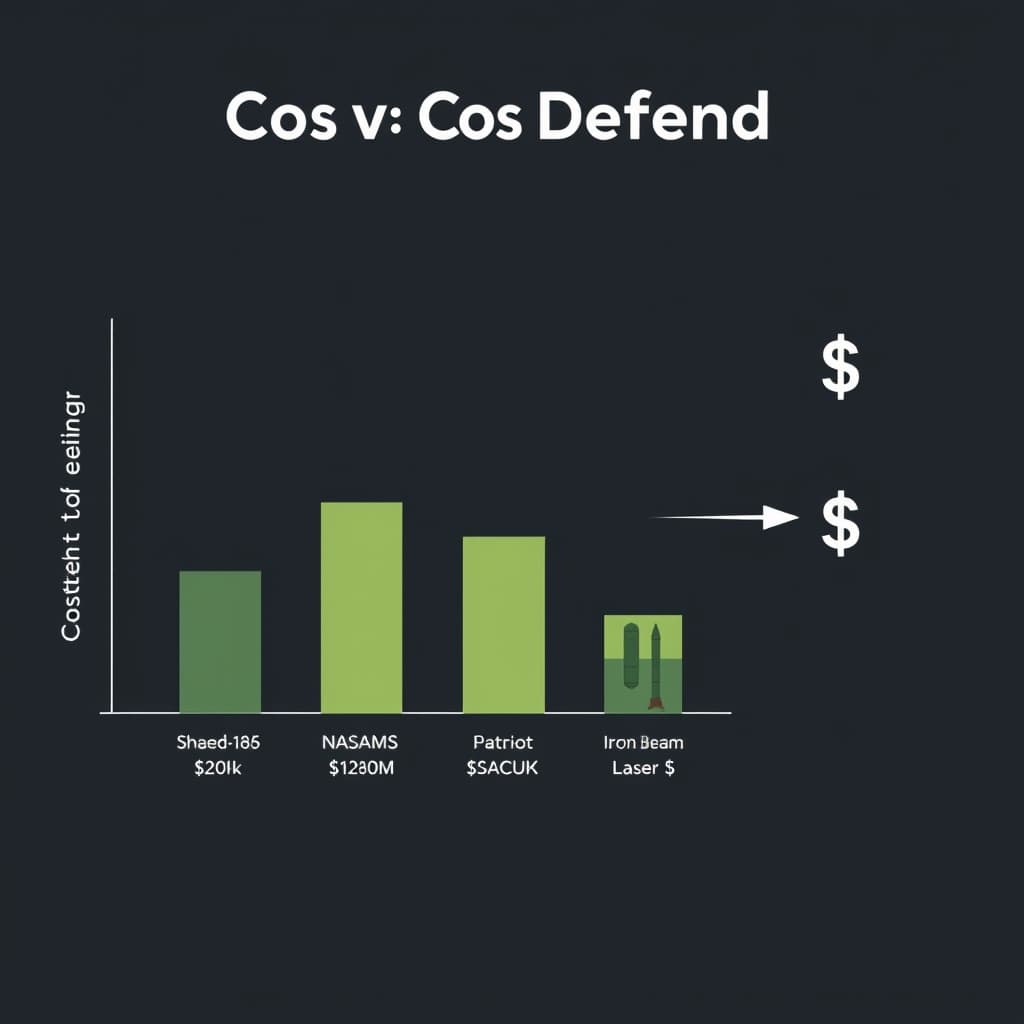
The Arithmetic of Attrition: When Defense Costs Exceed Offense by 100x
The current paradigm of Integrated Air and Missile Defense (IAMD) relies on a stockpile of interceptors that are technically brilliant but economically ruinous. We are effectively using Ferraris to chase disposable Toyotas.
The 1:100 Disparity
The mathematics of this asymmetry are stark. A Shahed-136 or similar Class III loitering munition costs approximately $20,000 to $50,000 to manufacture. In contrast, a single MIM-104 Patriot PAC-3 MSE interceptor commands a price tag upwards of $4 million.
This 1:100 cost ratio creates a scenario where a 100% interception rate is actually a strategic defeat. If an adversary launches a swarm of ten drones (total cost: $200k) and the defender engages them with ten high-end interceptors (total cost: $40M), the attacker has achieved a 200x return on investment without a single warhead detonating on a target. The defender is bleeding capital at a rate that no defense budget—not even the Pentagon’s—can sustain over a protracted conflict.
The Stockpile Crisis: Lead Times vs. Burn Rates
The crisis extends beyond immediate costs to industrial base capacity. The replenishment rate for high-end interceptors is measured in years, governed by the availability of solid rocket motors, complex guidance chips, and clean-room assembly lines. Conversely, the "low-slow-small" threat vectors are built with commercial-off-the-shelf (COTS) components found in consumer electronics and automotive supply chains.
The strategic implication is a "magazine depth" failure. An adversary does not need to destroy the Patriot battery; they only need to empty it. Once the high-value magazines are depleted on low-value targets, the airspace is left wide open for cruise missiles and aircraft—the threats the system was actually designed to stop.
Commoditized Swarms: How Low-Tech Drones Exhaust High-Tech Stockpiles
The tactical innovation here is the weaponization of volume. By commoditizing the delivery system, adversaries have shifted the bottleneck from technology to logistics.
The Strategy of Saturation
Saturation attacks are designed to overwhelm the "engagement logic" of air defense systems. Radar systems like the AN/MPQ-65 have a limit on the number of tracks they can process and engage simultaneously. By flooding the zone with cheap decoys and loitering munitions, attackers force the defense system's algorithms to make high-stakes prioritization decisions in milliseconds.
If the system engages the cheap drones, it wastes premium stock. If it ignores them, those drones strike critical infrastructure like radar dishes or power grids. This creates a "lose-lose" decision matrix for the defender, forcing the deployment of multimillion-dollar assets against targets that are financially negligible.
Map of Incentives: The Asymmetry of Production
To understand why this shift is accelerating, we must look at the incentive structures driving both sides.
The traditional defense prime is incentivized to build the "perfect" missile because a missed interception of a nuclear-capable threat is unacceptable. However, this perfectionism becomes a liability when the threat changes to a disposable swarm.
The Directed Energy Pivot: Escaping the Kinetic Cost Trap
To restore economic parity, defense strategy is pivoting toward Directed Energy Weapons (DEW)—specifically High Energy Lasers (HEL) and High Power Microwaves (HPM).
The Economics of Light
The primary allure of DEW is the collapse of the marginal cost of interception. A laser system like Israel’s "Iron Beam" or the UK’s "DragonFire" operates on a cost-per-shot basis of roughly $2 to $10—the cost of the electricity required to generate the beam. This effectively inverts the economic equation back in favor of the defender.
If a $10 laser shot can down a $20,000 drone, the attacker is now on the wrong side of the cost curve. Furthermore, the "magazine" is limited only by the power source, theoretically allowing for infinite engagements as long as the generator runs.
Technical Hurdles: Why Lasers Aren't a Silver Bullet Yet
Despite the economic promise, DEW systems face significant physical constraints that prevent them from being a standalone solution:
- Atmospheric Attenuation: Lasers lose coherence and power in rain, fog, smoke, or sandstorms. A kinetic missile works in a hurricane; a laser does not.
- Thermal Blooming: High-energy beams heat the air they pass through, creating a lensing effect that defocuses the beam over distance.
- Dwell Time: Unlike a missile that destroys on impact, a laser must hold its focus on a moving target for several seconds to burn through the casing. This limits the ability to handle massive, simultaneous swarms compared to HPM (Microwaves), which can fry electronics over a wide arc.
Redefining Procurement: The Shift from Gold-Plated to Mass-Producible
The solution to the $2M missile problem requires a cultural overhaul in how the West buys weapons. We are moving from an era of "Exquisite Systems" to "Attritable Mass."
The Rise of the "Interceptor Drone"
New entrants in the defense space, such as Anduril Industries and Shield AI, are pioneering the concept of the "interceptor drone." Systems like the Roadrunner-M are jet-powered, vertical-takeoff autonomous air vehicles that can intercept a target or, crucially, return to base and land if not needed.
This reusability changes the calculus. If an interceptor costs $200,000 but can be reused 50 times, the amortized cost per mission drops drastically. This bridges the gap between the $2 laser and the $4 million Patriot.
Software-Defined Defense
The future of air defense lies in software-defined integration. The US Army’s IBCS (Integrated Battle Command System) aims to connect any sensor to any shooter. This allows a high-end radar to guide a low-cost cannon shell or a cheap drone interceptor, optimizing the "cost per kill" in real-time. The algorithm selects the cheapest available effector that can guarantee a kill, rather than defaulting to the most expensive missile in the battery.
Conclusion
Financial solvency is now a tactical requirement. The era of firing gold bars at flying lawnmowers is over. The future of air defense depends not on building a better missile, but on radically lowering the marginal cost of interception to restore economic parity. If Western defense establishments cannot reduce the cost of defense faster than adversaries can reduce the cost of attack, the most sophisticated air defense networks in the world will be defeated not by physics, but by bankruptcy.
FAQ
What is the cost ratio between a Shahed drone and a Patriot missile? The disparity is staggering; a Shahed-136 is estimated to cost between $20,000 and $50,000, while a single Patriot PAC-3 interceptor can cost upwards of $4 million, creating a financial asymmetry that favors the attacker.
Can directed energy weapons completely replace kinetic missiles? Not currently. While lasers offer a negligible cost-per-shot (often under $10), they suffer from range limitations, weather sensitivity (rain/fog), and dwell-time requirements, making them a complementary layer rather than a total replacement for kinetic interceptors.
Sources
- Center for Strategic and International Studies (CSIS): Missile Defense and Defeat
- Congressional Research Service: U.S. Army’s Initial Maneuver Short-Range Air Defense (IM-SHORAD) System
- Royal United Services Institute (RUSI): Mass Precision Strike
- U.S. Department of Defense: 2024 National Defense Industrial Strategy
Related
View all →