

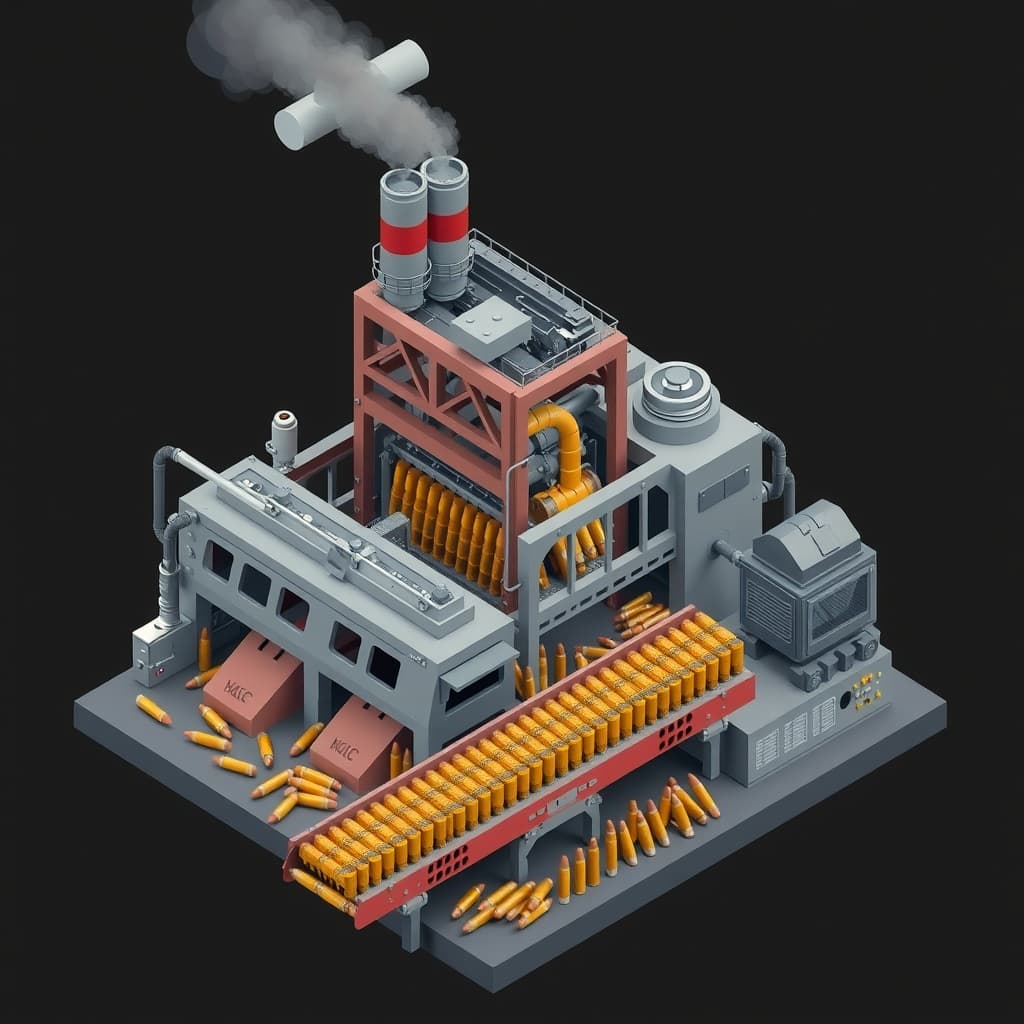
The Autophagy Trap: How Russia is Liquidating Its Future for Today's Ammo
The Central Bank of Russia’s key interest rate currently hovers near 21%—a figure usually reserved for failed states or economies in freefall—yet the Kremlin reports GDP growth that outpaces the G7. This is not an economic miracle; it is an accounting hallucination. We are witnessing a textbook case of Structural Economic Autophagy.
In biology, autophagy is a survival mechanism where the body consumes its own cells to stay alive during starvation. Applied to macroeconomics, this describes a state where a nation liquidates its critical infrastructure, human capital, and future revenue streams to fuel immediate, single-use military output. The Russian economy has ceased to function as a system of value creation and has morphed into a machine of value destruction, burning its furniture to keep the house warm.

The Illusion of GDP Growth in a Cannibalistic System
Standard economic indicators have failed to capture the reality of Russia's trajectory because they measure activity, not value. When a government pays a factory to build a tank, and pays a soldier to drive that tank, GDP rises. When that tank is destroyed three weeks later, the GDP gain remains on the books, but the national wealth has vanished.
This is the "Broken Window Fallacy" writ large. We are observing a shift from a productive economy to a Necro-Economy, where the primary driver of growth is the production of death and the compensation for it.
Military Keynesianism vs. Value Creation
The core issue is the Return on Investment (ROI) of government spending. In a healthy economy, CapEx (Capital Expenditure) goes into roads, schools, or fiber optics—assets that reduce friction and increase productivity for decades. Russia has redirected its CapEx into what is effectively "Kinetic OpEx."
- Civilian Multiplier: $1 billion in infrastructure yields ~$1.5 billion in long-term economic activity.
- Military Multiplier: $1 billion in artillery yields $0 in future economic activity once the shell is fired.
The chart below illustrates the divergence between reported growth and actual wealth accumulation.
The Inflationary Pressure Cooker
To sustain this output, the state is injecting massive liquidity into the defense sector. This money eventually leaks into the general consumer market (via soldier wages and death benefits), chasing a shrinking supply of consumer goods. The Central Bank’s aggressive rate hikes are a desperate attempt to mop up this liquidity, but monetary policy cannot fix a structural supply-side collapse.
Stripping the Civilian Sector: Anatomy of Industrial Regression
The most visible symptom of autophagy is the cannibalization of high-tech industries to support low-tech warfare. Russia is not just failing to modernize; it is actively aggressively de-modernizing.
The 'Spare Parts' Economy: A Case Study in Aviation
The Russian civilian aviation sector offers the clearest example of this regression. Cut off from Boeing and Airbus maintenance, carriers like Aeroflot have institutionalized "fleet cannibalization."
- The Mechanism: Functional aircraft are grounded and stripped of engines, avionics, and landing gear to keep other planes flying.
- The Cost: This reduces the total asset value of the fleet daily. An aircraft stripped for parts loses nearly 100% of its value, effectively turning a $100M asset into zero to defer a maintenance crisis for a few months.
- The Outcome: Safety margins evaporate. By 2026, the cumulative fatigue on airframes and the lack of certified software updates will likely ground a significant portion of the fleet, severing internal logistics in the world's largest country by landmass.
Reverse Industrialization
We are seeing a shift from global supply chains to autarkic inefficiencies. Advanced manufacturing requires microchips and precision tooling. With these sanctioned, Russian industry is substituting complex components with cruder, domestic alternatives or gray-market imports at a 200-300% markup.
This creates a Negative Learning Curve. Instead of becoming more efficient over time, Russian industry is becoming less efficient, more expensive, and lower quality. They are relearning how to build cars without ABS and airbags—a technological regression of thirty years.
The Human Capital Deficit: When Workforce Becomes War-force
Capital can be printed; talent cannot. The most damaging form of autophagy is the consumption of the workforce. The mobilization of 300,000+ men, combined with the exodus of nearly a million distinct IT specialists, engineers, and creatives, has created a demographic vacuum that no amount of oil revenue can fill.
The Labor Crunch Paradox
Record-low unemployment is often cited as a strength. Here, it is a critical warning sign. It indicates a labor market with zero slack. The defense sector is cannibalizing the civilian workforce by offering wages 3-4x the national average.
- The Drain: A welder working on a pipeline (revenue generating) is lured to a tank factory (revenue consuming).
- The Gap: The IT sector estimates a shortage of 500,000 to 700,000 developers. These are the architects of the future digital economy, and they are currently residing in Georgia, Armenia, or Dubai.
- Long-term Impact: The "brain drain" is permanent. High-skilled workers who leave rarely return to a regime with closed borders and capital controls.
Map of Incentives: Who Wins and Who Loses?
Understanding the persistence of this system requires looking at the incentives.
-
Short-Term Winners:
- The Defense Industrial Complex: Guaranteed state contracts with fat margins.
- Low-Skill Labor: Men from depressed regions seeing 500% wage increases by enlisting or working in factories.
- Gray Market Intermediaries: Entities in Kazakhstan, Turkey, and China facilitating sanctions evasion.
-
Long-Term Losers:
- The Civilian SME Sector: Cannot compete with defense wages; facing 21% cost of capital.
- Infrastructure: Roads, utilities, and housing stock degrading due to deferred CapEx.
- The Next Generation: Inheriting a hollowed-out industrial base and a pariah currency.
Post-2025 Trajectory: The Liquidation Crisis
The current model has a hard time horizon. Autophagy works until you run out of fat and muscle. Based on current burn rates of sovereign wealth funds and asset degradation, the inflection point likely arrives between late 2025 and mid-2026.
The Asset Vacuum
When the war spending eventually curtails—whether through peace, armistice, or fiscal exhaustion—the withdrawal of liquidity will trigger a massive shock. The "Rust Belt" effect will be instantaneous. Industrial hubs revitalized by defense spending will collapse as orders vanish, but the civilian industries that once employed these people will no longer exist to absorb them.
We project a scenario of Stagflationary Shock: high inflation driven by supply constraints, coupled with mass unemployment as the military-industrial bubble bursts.
What Would Change My Mind?
Two specific scenarios could delay this collapse, though likely not prevent it:
- A "Marshall Plan" from Beijing: If China decides to treat Russia not as a resource colony but as a strategic partner requiring massive infrastructural investment, they could plug the CapEx hole. Currently, China is extracting value (cheap oil), not injecting it.
- Sustained Oil at $150+: If a broader Middle East conflict drives oil prices to historic highs for 24+ months, the influx of petrodollars could allow Russia to import its way out of autophagy, effectively buying a new economy to replace the one it ate.
The Timeline of Organ Failure
Russia is not "surviving" sanctions; it is liquidating its future to pay for its present. The stability we see is the adrenaline of a system in fight-or-flight mode. By 2026, the cumulative lack of investment in energy extraction, transport, and education will manifest not as a slow decline, but as sudden systemic failures—pipelines bursting, planes grounded, and a currency that no longer stores value. The muscle will be gone, leaving only bone.
Sources
Related
View all →