


The OS is the New Browser: How Native Multi-Agent Search Kills the Ten Blue Links
Digital strategy leaders relying on organic search traffic for customer acquisition face an immediate structural risk: the decoupling of "search" from the "browser." The integration of Perplexity into Samsung’s Galaxy AI is not merely a feature update; it represents a fundamental architectural shift where query processing moves into the operating system's native layer. This transition threatens to render the traditional "ten blue links" model—and the SEO economy built upon it—obsolete.
This analysis examines the technical mechanics of Native Multi-Agent Search Layers, the economic leverage shifting from software giants to hardware OEMs, and the necessary pivot from Search Engine Optimization (SEO) to Agent Optimization (AEO).
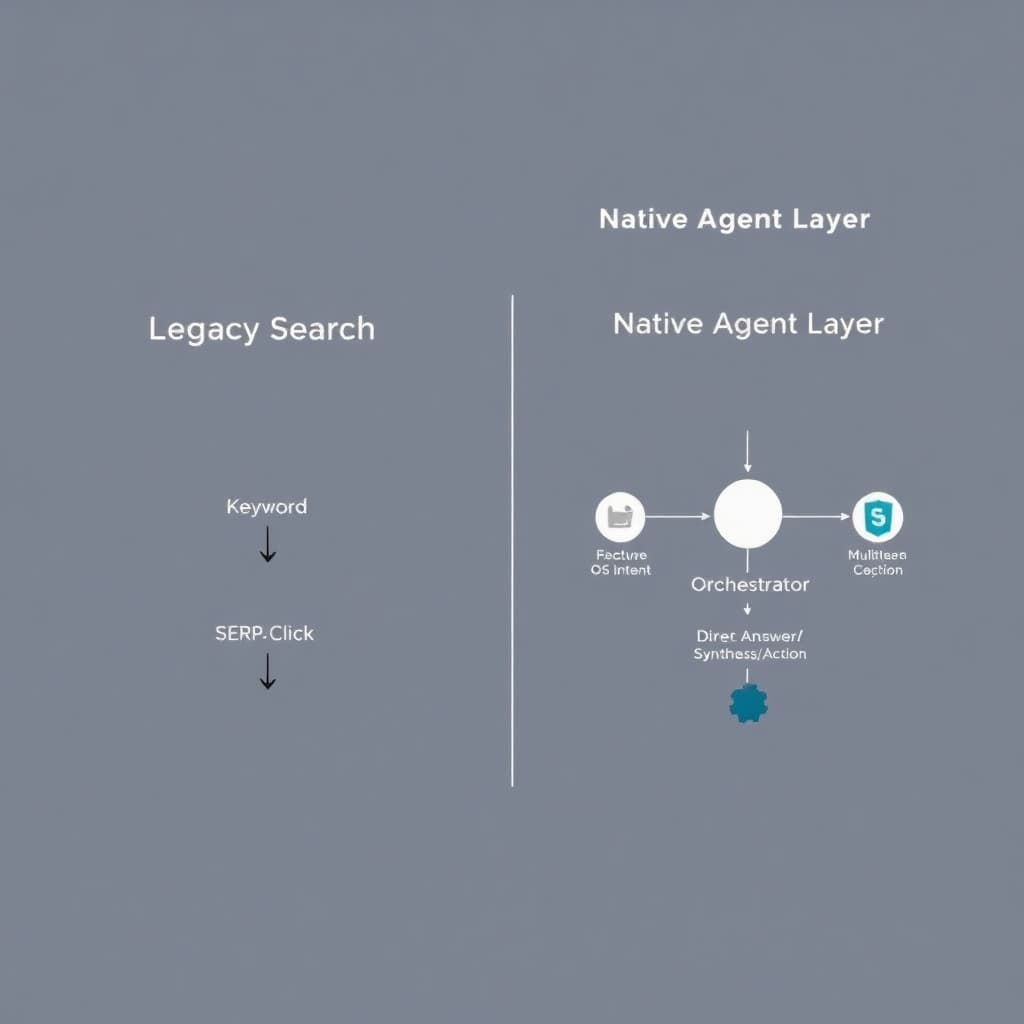
Deconstructing the OS-Level Orchestrator
The browser was designed as a passive window to the web, restricted by sandboxing protocols that prevent it from reading data in other applications. Native Multi-Agent Search Layers invert this model. The operating system itself becomes the search engine, utilizing a central "Orchestrator" to interpret user intent before determining whether to query the web, search local files, or trigger a specific application.
Bypassing the Browser Sandbox
In a traditional workflow, a user reading an email about a flight delay must copy the flight number, open Chrome, paste the number, and parse the results. An OS-level agent, however, possesses cross-app context. It reads the screen state (the email), identifies the entity (flight number), and proactively queries a flight tracking API without the user ever launching a browser.
This capability relies on Large Action Models (LAMs) that understand user interface elements. By moving the inference layer to the device (or a hybrid cloud/device architecture), the OS bypasses the browser's security sandbox. The "search" is no longer a request for a list of websites; it is a request for data synthesis based on the user's immediate digital context.
Indexing Intent vs. Indexing Pages
Legacy search engines index documents (HTML). Native agents index "intents" and "capabilities." When a user queries a Galaxy AI-enabled device, the Orchestrator does not look for keywords matching web pages. Instead, it classifies the request into an intent slot (e.g.,
informational_retrieval, transactional_booking, device_control).If the intent is informational, it may dispatch a sub-agent (like Perplexity) to retrieve and summarize web data. If the intent is transactional, it routes the request to a specific app API. This architectural change effectively demotes the general-purpose search engine from a primary interface to a backend data utility.
The Samsung-Perplexity Wedge: Breaking Google's Grip
Samsung’s decision to integrate Perplexity as a default engine within its AI stack is a calculated move to disrupt the search monopoly using hardware leverage. For over a decade, Google has paid billions annually to remain the default search engine on mobile devices. Native Multi-Agent Search renders this contract less valuable by intercepting the query before it reaches the browser.
Hardware Leverage and the Interface War
Hardware manufacturers (OEMs) control the physical entry point—the side button, the wake word, and the notification shade. By embedding search capabilities into these hardware triggers, OEMs are reclaiming the customer relationship from software providers.
This shift allows OEMs to treat search providers as interchangeable modular components. Today, Samsung uses Perplexity for answers and Google for images. Tomorrow, they could switch the text provider to OpenAI or Anthropic via a simple firmware update, forcing AI providers to compete on API pricing and latency rather than brand loyalty.
Economics: API Answers vs. Ad-Supported SERPs
The economic divergence between these models is stark.
The native agent model destroys ad inventory. If the OS provides a direct answer synthesized from three sources, the user never sees the banner ads on the source websites, nor the sponsored links on a Search Engine Results Page (SERP). This forces a migration toward subscription models or hardware-bundled services.
The Collapse of the 'Ten Blue Links' Economy
The "Ten Blue Links" served as the fundamental currency of the open web, facilitating a value exchange where publishers provided content in return for traffic and monetization opportunities. Native search layers sever this link.
Publisher Crisis: The End of Referral Traffic
Gartner predicts that search engine volume will drop by 25% by 2026 due to AI chatbots and virtual agents. For publishers, this is a volume crisis. When an OS-level agent summarizes a news article or a "best of" review, the attribution is often relegated to a small footnote or a citation link that few users click.
The value proposition for content creators shifts from "optimizing for clicks" to "optimizing for inclusion." If an agent does not ingest and trust a publisher's data, that publisher effectively ceases to exist in the mobile ecosystem.
Pivoting to Agent Optimization (AEO)
Search Engine Optimization (SEO) focused on keywords and backlinks. Agent Optimization (AEO) focuses on structure, authority, and API accessibility. To survive, brands must structure their data so that Large Language Models (LLMs) can easily parse and verify it.
Key AEO Strategies:- Schema Markup: Heavy use of structured data (JSON-LD) to explicitly define entities (prices, dates, SKUs).
- Brand Authority: Agents prioritize sources with high "trust scores" to avoid hallucinations. Niche expertise becomes more valuable than broad, shallow content.
- Direct Data Feeds: providing data directly to LLM training sets or via plugins, rather than waiting for a crawler to find it.
From Answer Engines to Action Layers (2026-2030)
The current iteration of native search focuses on information retrieval. The next phase, maturing between 2026 and 2030, will focus on complex task execution.
Transactional Agents
By 2027, the primary metric for mobile AI will shift from "answer accuracy" to "task completion rate." A user will say, "Book a table for two at an Italian restaurant near me for 7 PM." The OS agent will:
- Query a map API for location.
- Query a review API for "Italian" and ratings.
- Access the user's calendar to verify availability.
- Interface with a reservation platform (e.g., OpenTable) to execute the booking.
In this scenario, the "search result" is a calendar confirmation, not a list of restaurants. The economic value captures the transaction fee, bypassing the aggregator websites entirely.
The Privacy Battleground: On-Device vs. Cloud
As agents process highly sensitive data (financials, health, communications) to perform these actions, privacy becomes the defining competitive differentiator. Apple and Samsung are aggressively investing in Small Language Models (SLMs) capable of running entirely on-device (NPU).
Cloud-based orchestration offers superior intelligence but higher latency and privacy risks. The market will likely bifurcate: "Free" agents that process data in the cloud (monetized via data usage) versus "Pro" agents that process data locally on premium hardware (monetized via device cost).
Strategic Prediction
Falsifiable Claim: By Q4 2027, Google will launch a "headless" search API specifically designed for third-party OS agents, cannibalizing its own SERP ad revenue to maintain data dominance. Indicators to Watch:
- Google creates a distinct "Agent Access" tier in Google Search Console.
- A significant decline in mobile browser market share for Chrome on Android devices.
- Introduction of "Sponsored Citations" within AI-generated answers as a new ad unit.
Conclusion
Search is evolving from a destination app into an invisible utility woven into the fabric of the operating system. For hardware manufacturers, this is an opportunity to break the software duopoly. For brands and publishers, it is an extinction-level event for traffic-dependent business models. Success in this new era requires abandoning the chase for clicks and focusing on becoming the trusted, structured data source that the operating system relies upon to answer the user.
FAQ
What defines a native multi-agent search layer? It is a system embedded directly into the operating system that uses multiple specialized AI agents to process queries and execute tasks across applications without requiring the user to open a web browser.
How does this impact traditional digital advertising? It significantly reduces inventory for traditional display ads and sponsored search links (SERP), forcing advertisers to explore native integration, sponsored citations, or influence agent recommendations directly.
Sources
Related
View all →