


The Silent Arms Race: Inside the Rise of Covert Sovereign Hashrate
The strategic divergence between public regulatory hostility and private accumulation of digital assets creates a specific risk for global policymakers and institutional allocators: mispricing the geopolitical floor of the Bitcoin network. While headlines focus on retail adoption or ETF inflows, a more consequential shift is occurring in the energy sectors of developing nations. This analysis dissects the implications of recent findings—specifically the VanEck report identifying thirteen governments quietly accumulating mining infrastructure—to provide a framework for understanding Bitcoin not as a speculative asset, but as a strategic energy derivative.
The narrative has shifted from prohibition to acquisition. For over a decade, the dominant regulatory question was how to ban or control decentralized currencies. Today, the question for sovereign entities is how to secure a position in the hashrate market before the entry cost becomes prohibitive. This pivots the asset class from a financial novelty to a matter of national security, comparable to gold reserves or strategic petroleum stockpiles.
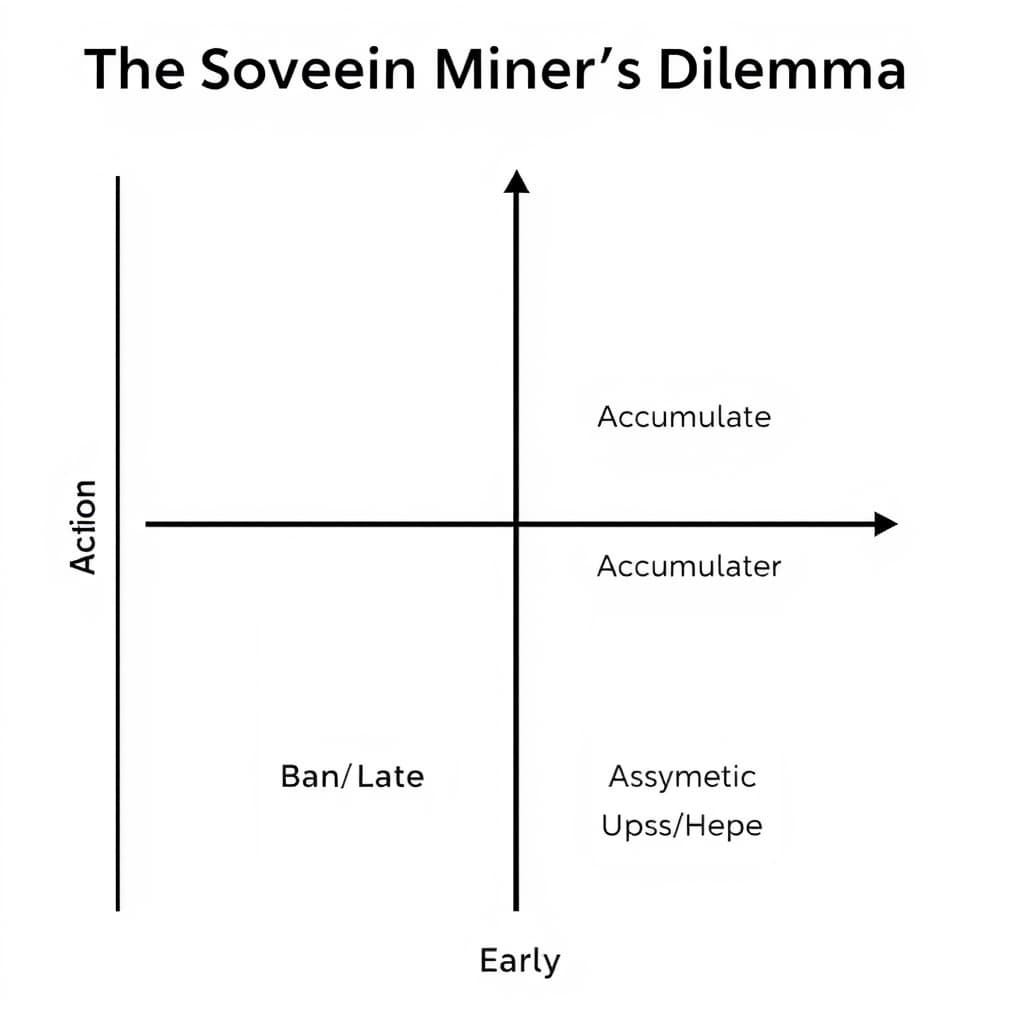
From Regulation to Extraction: The Mechanics of State-Sponsored Mining
The operational model for sovereign mining differs fundamentally from commercial enterprise. While private miners are beholden to shareholder returns and immediate profit margins, state actors operate with longer time horizons and different cost bases. The primary mechanism driving this trend is the utilization of stranded energy assets—power that is generated but cannot be economically transmitted to population centers.
Leveraging Stranded Energy Assets
Governments are increasingly viewing Bitcoin mining as a load-balancing tool for national grids. In regions with abundant hydroelectric or geothermal capacity but insufficient transmission infrastructure, the "export" of energy via physical cables is financially unviable.
By deploying mining fleets directly at the source, states can monetize excess capacity without reliance on cross-border physical infrastructure. This effectively transforms energy into a liquid, globally tradable asset without the friction of logistics or the geopolitical vulnerability of pipelines. For nations in the Global South, this offers a mechanism to bypass the capital-intensive requirements of building export grids, turning wasted joules into sovereign reserves.
The Shift to Enterprise-Grade Procurement
Historical state involvement was often predatory, characterized by the seizure of illicit rigs from private operators—a tactic observed in jurisdictions like Venezuela and parts of China. However, the current phase involves direct procurement. Customs data and supply chain analysis indicate a shift toward the state purchase of enterprise-grade ASIC fleets. This transition from confiscation to capital expenditure signals a long-term commitment to infrastructure maintenance rather than opportunistic revenue grabbing.
Case Study: Decoding the 'Dark 13' and the Bhutan Model
To understand the covert behavior of the thirteen nations alluded to in recent institutional research, one must look at the precedent set by the Kingdom of Bhutan. For years, Bhutan’s sovereign investment arm, Druk Holding & Investments (DHI), mined Bitcoin using the nation's vast hydroelectric surplus. This operation remained undisclosed until satellite imagery and bankruptcy filings from lending partners revealed the scale of the infrastructure.
Correlating Import Data with Energy Anomalies
Identifying the remaining nations in the "Dark 13" requires a forensic approach to trade and energy data. Researchers look for specific anomalies:
- ASIC Import Spikes: Sudden increases in semiconductor imports classified under HS codes for data processing machinery in nations with no corresponding growth in tech sectors.
- Baseload Power Deviations: Unexplained increases in industrial power consumption in remote regions, particularly near hydroelectric dams or oil fields with high flare rates.
The BRICS Strategic Pivot
The geopolitical alignment of these likely miners is not random. There is a strong correlation between nations expressing interest in de-dollarization (primarily BRICS+ members) and those suspected of covert mining. For these states, hashrate represents a neutral settlement layer. Unlike gold, which requires physical transport and custody, or fiat currencies, which are subject to issuer debasement and seizure, Bitcoin mined domestically provides a sovereign bearer asset that exists outside the purview of the OECD financial stack.
The Geopolitics of Hashrate: Hedging Against Dollar Hegemony
The driver for this silent arms race is less about capital appreciation and more about monetary sovereignty. As the weaponization of the SWIFT network increases, nations identified as adversarial to Western interests are seeking liquidity rails that cannot be interdicted by the U.S. Treasury’s Office of Foreign Assets Control (OFAC).
Mining as a Sanctions-Resistant Liquidity Rail
For a sanctioned nation, selling oil or natural gas usually involves complex laundering networks or accepting local currencies with poor convertibility. Bitcoin mining simplifies this equation. By converting energy directly into Bitcoin, a state can bypass the banking sector entirely. The resulting Bitcoin can be used to pay for imports from other non-aligned nations or sold on peer-to-peer markets for hard currency. This creates a "closed-loop" economy where energy is the input and global purchasing power is the output, with no intermediary to block the transaction.
Map of Incentives: The Sovereign Mining Ecosystem
The Militarization of the Mempool: Risks and Scenarios (2026-2030)
As sovereign entities capture a larger percentage of total network hashrate, the risks evolve from financial to kinetic. By 2026, we anticipate that state-controlled hashrate could exceed 20-25% of the global total, fundamentally altering the threat model for the network.
Transaction Censorship and Soft-Fork Wars
The immediate risk is not a 51% attack, which destroys the value of the asset the state is mining, but rather "soft" censorship. A coalition of Western-aligned sovereign miners might enforce OFAC compliance at the protocol level, refusing to build on blocks that contain transactions from sanctioned addresses. Conversely, an opposing bloc could refuse to recognize those compliant blocks. This could lead to a "balkanization" of the chain, or soft-fork wars, where the consensus rules are challenged by geopolitical alliances rather than technical disagreements.
Critical Infrastructure Targets
Once mining facilities are recognized as essential for national liquidity, they become valid military targets. In a conflict scenario, kinetic strikes against a rival nation's server farms or the power plants feeding them become a logical strategy to degrade their financial resilience. We are moving toward a paradigm where the physical security of mining data centers will require military-grade defense, indistinguishable from the protection afforded to central bank vaults.
The window for neutrality is closing. The entry of thirteen governments into the mining sector validates the thesis that hashrate is a strategic resource. For policymakers and investors, the implication is clear: Bitcoin is no longer just a volatile asset to be regulated, but a geopolitical capabilities race that is already underway.
FAQ
Why would governments mine Bitcoin secretly rather than publicly? Covert operations allow nations to evade international sanctions, avoid immediate diplomatic backlash from bodies like the IMF or World Bank, and accumulate a strategic position at a lower cost basis before signaling a policy shift to the global market.
Does sovereign mining threaten Bitcoin's decentralization? While it introduces large, powerful actors, the geographic and ideological distribution of these rival nations actually reinforces network security. Opposing geopolitical blocs (e.g., NATO vs. BRICS) are unlikely to collude on a 51% attack, as their strategic goals are mutually exclusive.
Sources
- VanEck – Analysis on sovereign mining trends and nation-state adoption.
- Forbes – Report on Bhutan’s Druk Holding & Investments covert mining operations.
- Chainalysis – Data on cryptocurrency usage for sanctions evasion and illicit finance.
- International Monetary Fund (IMF) – Reports regarding the macro-financial implications of crypto assets in emerging markets.
Related
View all →
Crypto
Circle's Native Gas Abstraction: How Eliminating Network Fees Rewires Crypto Architecture
March 27, 2026
...


Crypto
When TradFi Meets Stablecoins: Inside the Circle and Mastercard Infrastructure Play
March 13, 2026
...