

When TradFi Meets Stablecoins: Inside the Circle and Mastercard Infrastructure Play
In August 2025, Arab Financial Services quietly executed a technical milestone that signaled the beginning of the end for legacy cross-border clearing: it became one of the first acquiring institutions in the Middle East to settle merchant transactions entirely in USDC over a major global card network. The convergence of legacy payment rails and fiat-pegged digital assets is no longer a theoretical whitepaper concept; it is actively replacing outdated correspondent banking systems. Operating as a policy and regulatory researcher analyzing payment system architecture for over 15 years, I view the recent expansion of the Circle and Mastercard alliance—now culminating in a massive 85-member Crypto Partner Program launched in March 2026—as the definitive blueprint for TradFi-Stablecoin Payment Integration.
Rewiring the Settlement Engine: How USDC Operates on Legacy Rails
Bypassing Correspondent Banking Bottlenecks
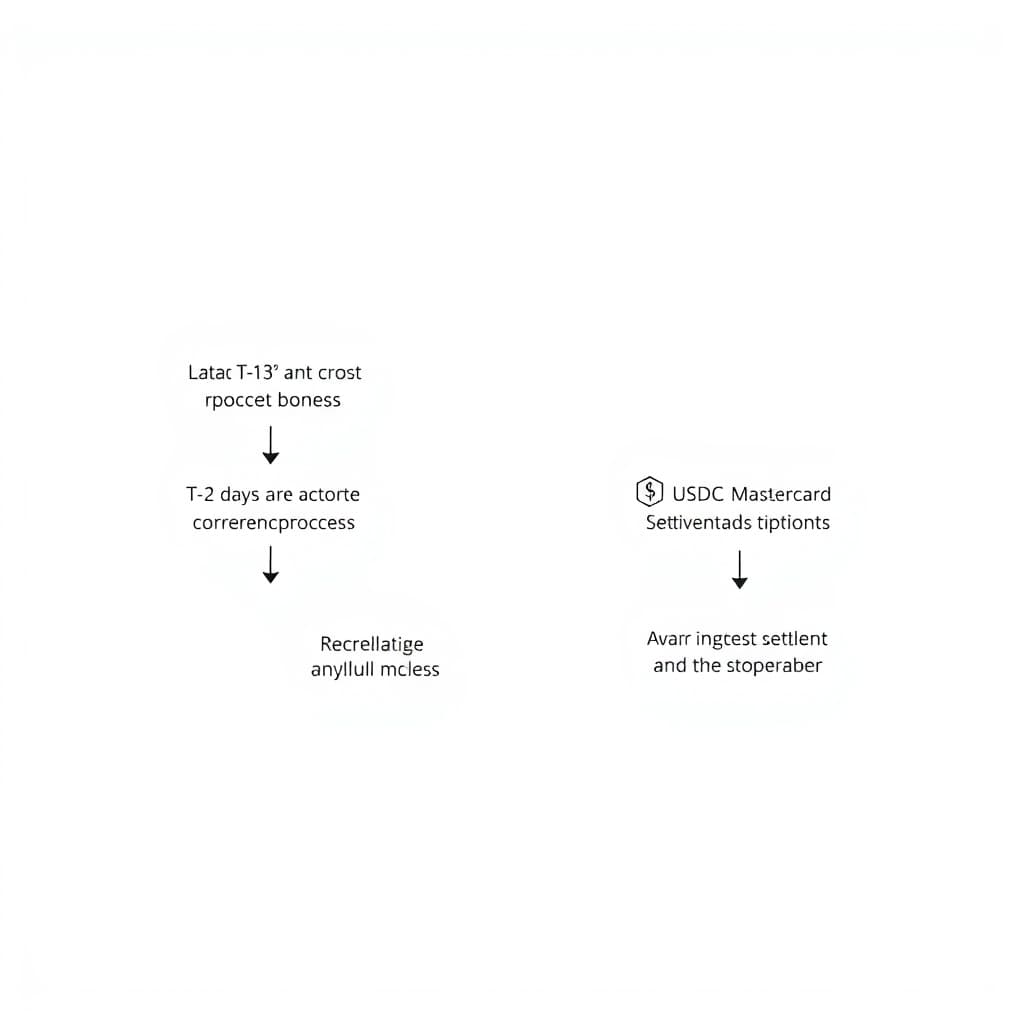
For decades, global commerce has relied on a fragile, fragmented network of correspondent banks. Moving fiat currency across borders requires navigating a labyrinth of Nostro and Vostro accounts, often resulting in T+2 (or worse) settlement delays, trapped liquidity, and unpredictable fee structures. This architecture is fundamentally incompatible with the velocity of modern digital commerce.
By integrating USDC directly into its settlement layer, Mastercard bypasses this archaic messaging system entirely. Instead of relying on a chain of intermediary banks to clear a cross-border transaction, the network utilizes public blockchain infrastructure to achieve atomic settlement. The acquiring bank receives cryptographic proof of funds instantly, unlocking working capital that would otherwise be tied up in transit for days. This operational upgrade shifts the paradigm from batch-processed, deferred net settlement to real-time, gross settlement.
The Mechanics of Fiat-to-Stablecoin Conversion at the Point of Sale
The genius of this infrastructure play lies in its invisibility to the end user. When a consumer initiates a payment using a Web3-linked Mastercard—such as those provisioned by infrastructure providers like Immersve—they are spending digital dollars held in a self-custodial or managed wallet.
At the point of sale, the network routes the authorization request just like a standard credit card swipe. Behind the scenes, the exact equivalent of the purchase price in USDC is deducted from the user's wallet and routed to the acquiring processor. The merchant receives their local fiat currency (e.g., Euros or Dirhams) exactly as they always have, bearing zero exposure to the underlying blockchain mechanics or cryptocurrency volatility. The complex cryptographic routing is completely abstracted away, leaving only the efficiency of the rail.
The Circle and Mastercard Alliance in Practice
Pilot Programs and Merchant Adoption Strategies
To understand the trajectory of this infrastructure, we must examine the specific regional deployments that served as proving grounds. The Eastern Europe, Middle East, and Africa (EEMEA) region emerged as the primary launchpad. In late 2025, Mastercard aggressively expanded its Circle partnership to allow acquiring banks in these jurisdictions to settle transactions in USDC and EURC.
Firms like NEO PAY in the UAE and INFINIOS in Bahrain adopted these stablecoin settlement capabilities to solve acute market needs for greater liquidity and operational efficiency. Fast forward to March 2026, and Mastercard has formalized this strategy by launching a Crypto Partner Program, bringing together over 85 crypto-native companies and financial institutions. This coalition shifts the focus entirely from retail speculation toward enterprise-grade use cases: B2B payments, global payouts, and cross-border remittances.
Consumer Friction Reduction Through Seamless Wallets
Mainstream adoption of blockchain technology has historically been bottlenecked by terrible user experiences—seed phrases, gas fees, and fragmented network standards. The Mastercard-Circle integration circumvents these barriers by embedding stablecoin spending directly into existing digital wallets.
Consumers can integrate their stablecoin debit cards into Apple Pay and Google Pay. The friction of onboarding into the digital asset ecosystem vanishes when the interface is a familiar biometric double-click on a smartphone. By retaining the familiar form factor of a payment card while upgrading the backend rails, Mastercard ensures that user behavior does not need to change to accommodate the new technology.
Institutional Validation: Why Global Networks Are Embracing Blockchain
Slashing Cross-Border Transaction Costs
Payment networks are ruthless optimizers. Mastercard is not integrating blockchain rails out of ideological alignment with the Web3 ethos; it is doing so to protect its margins and defend against disintermediation. Cross-border interchange and FX fees have long been cash cows for card networks, but they are increasingly under threat from closed-loop fintech alternatives.
By utilizing USDC, Mastercard drastically reduces the internal cost of moving value across distinct sovereign currency zones. While the consumer-facing fees may remain largely unchanged in the short term, the network and its acquiring partners capture the spread generated by eliminating third-party clearinghouses.
Regulatory Compliance and the Shift to Fully Reserved Assets
The integration of digital assets into systemic payment rails requires bulletproof regulatory clarity. The implementation of the Markets in Crypto-Assets (MiCA) regulation in the European Union and evolving stablecoin guidelines in the US have provided the necessary guardrails.
Mastercard chose Circle specifically because USDC operates as a fully reserved, regulated digital dollar. Unlike algorithmic stablecoins or offshore entities with opaque balance sheets, Circle provides transparent reserve attestations and operates within the strict licensing frameworks of major financial jurisdictions. Institutional risk committees will only greenlight blockchain integrations when the underlying asset carries zero counterparty default risk.
Map of Incentives: Who Wins and Who Loses?
The Next Five Years of Digital Fiat Integration
Programmable Payments and Smart Contract Automation
Looking toward the end of the decade, the basic settlement of fiat value is merely the foundational layer. The true disruptive potential of TradFi-Stablecoin Payment Integration lies in programmability. Because USDC exists as a smart contract on public blockchains, payments can be embedded with conditional logic.
Corporate treasuries will transition from static monthly payrolls to continuous, streaming micro-payments. B2B supply chain settlements will execute automatically the moment a digitized bill of lading is verified on-chain. Mastercard's infrastructure will serve as the trusted oracle connecting real-world commercial events to these automated on-chain payouts, capturing a toll on every programmatic execution.
Central Bank Digital Currencies vs. Private Stablecoin Networks
A fierce geopolitical debate continues regarding the role of Central Bank Digital Currencies (CBDCs). However, the market reality of 2026 suggests that private stablecoins running on public-private partnership networks have already won the race.
While central banks remain mired in privacy debates and bureaucratic pilot phases, private consortia have deployed functional, globally interoperable digital fiat. The Mastercard-Circle model proves that the market prefers the innovation speed of private enterprise combined with the regulatory oversight of existing banking frameworks, rather than waiting for direct central bank retail liabilities.
The convergence of established credit networks and digital dollars creates a formidable new standard for global commerce. Watch closely as competing payment giants scramble to establish their own blockchain alliances to protect their market share.
FAQ
How does the Circle and Mastercard integration handle transaction volatility? Because USDC is a fully reserved stablecoin pegged to the US dollar, price volatility is essentially eliminated. The network settles the transaction in fiat value almost instantaneously, shielding merchants from typical cryptocurrency price swings.
What are the regulatory hurdles for mainstream stablecoin payments? The primary challenges involve compliance with anti-money laundering directives and ensuring adequate reserve transparency. Major financial players mitigate these risks by partnering exclusively with regulated entities that provide monthly reserve attestations and adhere strictly to jurisdictional licensing requirements.
Sources
- Mastercard advances blockchain innovation through strategic alliances in the Middle East region
- Mastercard expands partnership with Circle to transform digital settlement for merchants and acquirers in region
- Circle helps Immersve bring digital dollars to everyday spending
- Mastercard launches crypto partner program with 85 companies to reshape global payments
- Markets in Crypto-Assets Regulation (MiCA) - ESMA
Related
View all →
Crypto
The Great Replatforming: Why LSEG’s Blockchain Pivot Signals the End of T+2 Settlement
February 20, 2026
...