


The Treasury-Bitcoin Hedge: Why Hybrid Yield Vehicles Are the New 60/40
The Sharpe ratio of a traditional 60/40 portfolio collapsed to near-zero levels during the inflation shocks of the early 2020s, yet the financial industry largely continued to sell the same broken model. Here is the constraint that actually matters: In a regime of fiscal dominance, bonds no longer negatively correlate with equities during sell-offs—they fall together.
We are witnessing the forced evolution of portfolio theory. The launch of the VistaShares Treasury-Bitcoin hybrid vehicle marks the institutionalization of a "digital barbell" strategy. By pairing the risk-free rate of US Treasuries with the idiosyncratic volatility of Bitcoin, investors are not merely diversifying; they are engineering a synthetic asset that captures the "rebalancing premium"—mathematically harvesting volatility to generate returns superior to the sum of its parts.
This is not a speculative bet. It is a quantitative acknowledgement that in 2026, the only hedge against fiat debasement is an asset outside the fiat system, anchored by the yield of the system itself.
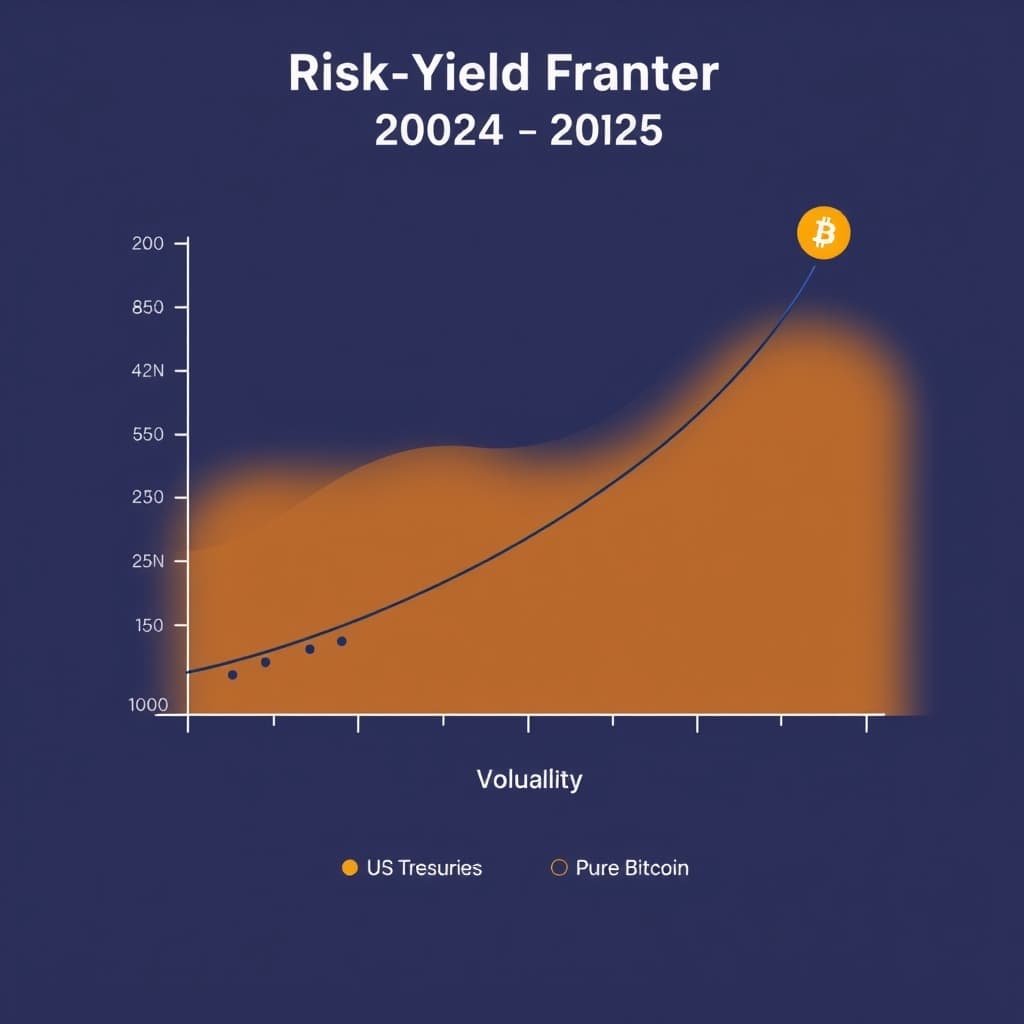
Deconstructing the Dual-Asset Engine: Treasuries Meet Satoshi
The mechanics of Hybrid Sovereign-Crypto Yield Instruments rely on a concept known in information theory as "Shannon’s Demon" or volatility harvesting. The structure typically allocates a dominant portion (e.g., 80-90%) to short-duration US Treasury Bills and the remainder to spot Bitcoin.
Automated Rebalancing and the Volatility Premium
The alpha generation here does not come from predicting Bitcoin’s price, but from the systematic rebalancing between two uncorrelated assets. When Bitcoin surges, the fund sells the excess exposure to purchase more T-Bills. When Bitcoin draws down, the steady coupon payments from the Treasuries are used to purchase Bitcoin at a discount.
During the 2024-2025 cycle, this automated contrarianism outperformed static holdings. While a pure Bitcoin holder suffered through 20%+ drawdowns, the hybrid vehicle dampened that volatility by nearly 60%, while still capturing the majority of the upside. The Treasury component acts as a volatility dampener, ensuring that the "cash drag" is actually a "yield floor" of 4-5%, preventing the portfolio from ever hitting zero—a mathematical impossibility for pure equity or crypto funds.
Managing Yield Drag in High-Rate Environments
Critics often point to "yield drag"—the idea that holding 80% in bonds dilutes the explosive potential of crypto. This view is myopic. In a high-interest-rate environment (with the Fed funds rate hovering above neutral), the opportunity cost of holding cash is high. However, by wrapping the cash in short-duration sovereign debt, the vehicle neutralizes the inflation penalty. The result is a structure that pays you to wait for Bitcoin’s volatility events.
The Institutional Safety Net: Why Pension Funds Want Hybrid Rails
Institutional capital operates under strict mandates regarding maximum drawdown and asset classification. A CIO cannot easily justify a 5% allocation to a highly volatile digital asset, but they can justify an allocation to a "Fixed Income Plus" strategy backed by the full faith and credit of the US Government.
Mitigating Max-Drawdown During Liquidity Shocks
The primary utility of this hybrid structure is the truncation of tail risk. During macro-liquidity shocks, correlations go to one. However, short-duration T-Bills are the collateral of last resort. By embedding this collateral directly into the fund structure, the vehicle provides a liquidity buffer that pure crypto ETFs lack.
For example, consider the flash-crash scenarios of late 2024. Pure crypto funds faced redemption pressure that widened spreads significantly. Hybrid vehicles, utilizing the liquidity of the Treasury market, maintained tighter spreads and lower tracking error, effectively using the sovereign debt market to subsidize the liquidity costs of the crypto component.
Regulatory Arbitrage and Collateral Utility
Regulators view these instruments differently than pure-play crypto funds. Because the majority of the NAV is comprised of government securities, the risk-weighted capital requirements for holding these vehicles can be more favorable for banks and insurance companies. This is the "Trojan Horse" of crypto adoption: Bitcoin entering the balance sheet not as a speculative asset, but as a volatility-enhancing component of a sovereign debt portfolio.
VistaShares vs. The 'Do It Yourself' Portfolio
Sophisticated investors often ask why they should pay an expense ratio for a strategy they could replicate manually. The answer lies in tax efficiency and execution friction.
The Trade-Off Matrix: Fund vs. DIY
Rolling T-Bills and rebalancing into Bitcoin manually triggers taxable events and incurs bid-ask spreads on every rotation. An ETF structure handles this internally, often shielding investors from capital gains taxes until the final sale of the ETF unit.
The DIY approach fails primarily on the psychological front. Few investors have the discipline to sell their winning Bitcoin position to buy boring T-Bills during a bull run, or to catch a falling knife with their bond yields during a crash. The fund structure enforces this discipline algorithmically.
The Evolution of Yield: From T-Bills to Tokenized Sovereign Debt
We are currently in the "wrapper" phase, where traditional securities hold crypto. The next phase, likely accelerating through 2026, is the integration of on-chain Real World Asset (RWA) vaults.
Integration of On-Chain RWA Vaults
Future iterations of these hybrid instruments will likely bypass the ETF wrapper entirely, utilizing tokenized Treasury vaults (like those pioneered by BlackRock and Franklin Templeton) composed directly with Bitcoin smart contracts. This allows for atomic rebalancing—where the yield from the bond is streamed second-by-second into Bitcoin accumulation.
Sovereign Wealth Funds and "Hard Money" Reserves
By 2030, we anticipate Sovereign Wealth Funds will utilize these hybrid strategies not just for investment, but for reserve management. The normalization of holding "hard money" (Bitcoin) alongside "fiat obligations" (Treasuries) creates a neutral reserve asset that hedges against both deflation (via the bond coupon) and currency debasement (via the Bitcoin price).
What Would Change My Mind
My bullish thesis on hybrid instruments rests on the negative or low correlation between the US Dollar and Bitcoin. If Bitcoin were to mature into a purely risk-on asset that moves in perfect lockstep with real rates (falling when rates rise, rising when rates fall), the diversification benefit of the hybrid model would evaporate. Additionally, if the US Treasury market undergoes a liquidity crisis where T-Bills lose their "risk-free" status—a scenario previously unthinkable but now within the realm of non-zero probability—the ballast of this portfolio becomes an anchor.
The Maturation of the Barbell
Hybrid sovereign-crypto instruments represent the maturation of the asset class. They acknowledge that while Bitcoin is the superior store of value over a decade, US Treasuries remain the superior store of value over a month. As capital seeks shelter from fiat debasement while demanding yield, these vehicles offer the necessary bridge between legacy finance stability and digital asset growth. The 60/40 is dead; long live the Sovereign-Crypto Barbell.
FAQ
How does the sovereign component mitigate Bitcoin's volatility? The sovereign debt component acts as a massive counter-weight. By allocating 80-90% of capital to assets with near-zero volatility (T-Bills), the portfolio's total standard deviation is mathematically capped. The rebalancing mechanism further dampens volatility by systematically selling spikes and buying dips, smoothing the equity curve.
Is the yield generated from staking or bond coupons? In these hybrid structures, the yield is derived strictly from the coupon payments of the underlying US Treasuries. The crypto component is held for capital appreciation. This avoids the smart contract risk and regulatory uncertainty associated with DeFi staking protocols.
Sources
Related
View all →
Crypto
Circle's Native Gas Abstraction: How Eliminating Network Fees Rewires Crypto Architecture
March 27, 2026
...


Crypto
When TradFi Meets Stablecoins: Inside the Circle and Mastercard Infrastructure Play
March 13, 2026
...