

The $580M Oil Play: Unpacking Asymmetric Executive-Signal Arbitrage
The $580M Oil Play: Unpacking Asymmetric Executive-Signal Arbitrage
A 400-millisecond latency window is all it took for market participants to deploy $580 million into highly leveraged crude oil positions just prior to a critical social media update regarding Iran negotiations. This massive capital deployment exposes a structural vulnerability in global commodities: the rapid monetization of unformalized geopolitical policy. Operating at the intersection of market microstructure and macroeconomic policy, this analysis utilizes the Commodity Futures Trading Commission’s (CFTC) Large Trader Reporting framework to examine how institutional players exploit these narrow windows. By capturing outsized returns before official state channels publish their mandates, high-frequency entities are fundamentally redefining modern liquidity absorption and price discovery.
The Mechanics of Pre-Announcement Leveraging
Identifying Information Asymmetry Windows
Asymmetric executive-signal arbitrage occurs when quantitative trading desks detect and act upon unformalized policy indicators before they are disseminated via traditional government wires. The friction between a political executive drafting a social media post and a state department issuing the corresponding official press release creates a micro-duration asymmetry window. During this brief period, algorithmic systems parse digital footprints—ranging from the flight tracking of diplomatic envoys to sudden shifts in the following/follower dynamics of key geopolitical accounts—to synthesize a probabilistic policy outcome. The primary constraint here is execution speed; the alpha decays to zero the exact moment the broader market's natural language processing (NLP) algorithms ingest the public post.
Anatomy of the $580 Million Trade Execution
Deploying half a billion dollars without triggering exchange circuit breakers or incurring massive slippage requires fragmented, high-velocity execution routing. In the recent Iran-related oil play, capital was dispersed across short-dated, out-of-the-money (OTM) call options on Brent crude and direct West Texas Intermediate (WTI) futures contracts. The immediate second-order effect of this sudden options buying is forced hedging by market makers. This dynamic artificially accelerates the underlying commodity's price momentum just as the geopolitical news breaks to retail and slower institutional participants. This mechanism severely impacts end-users of physical commodities, such as airlines and shipping fleets, who face sudden margin calls on their operational hedges due to purely speculative, signal-driven volatility.
Dissecting the Iran Negotiation Anomaly
Mapping the Timeline of the Executive Leak
In March 2026, global energy markets experienced a severe dislocation triggered by unofficial diplomatic communications. A pivotal update regarding US-Iran negotiations surfaced on a primary social media platform exactly 14 minutes before the State Department issued a formal statement. Within the first two minutes of the informal post, open interest in April Brent crude contracts surged exponentially. This event serves as a definitive case study in how asymmetric executive-signal arbitrage outpaces legacy regulatory reporting mechanisms.
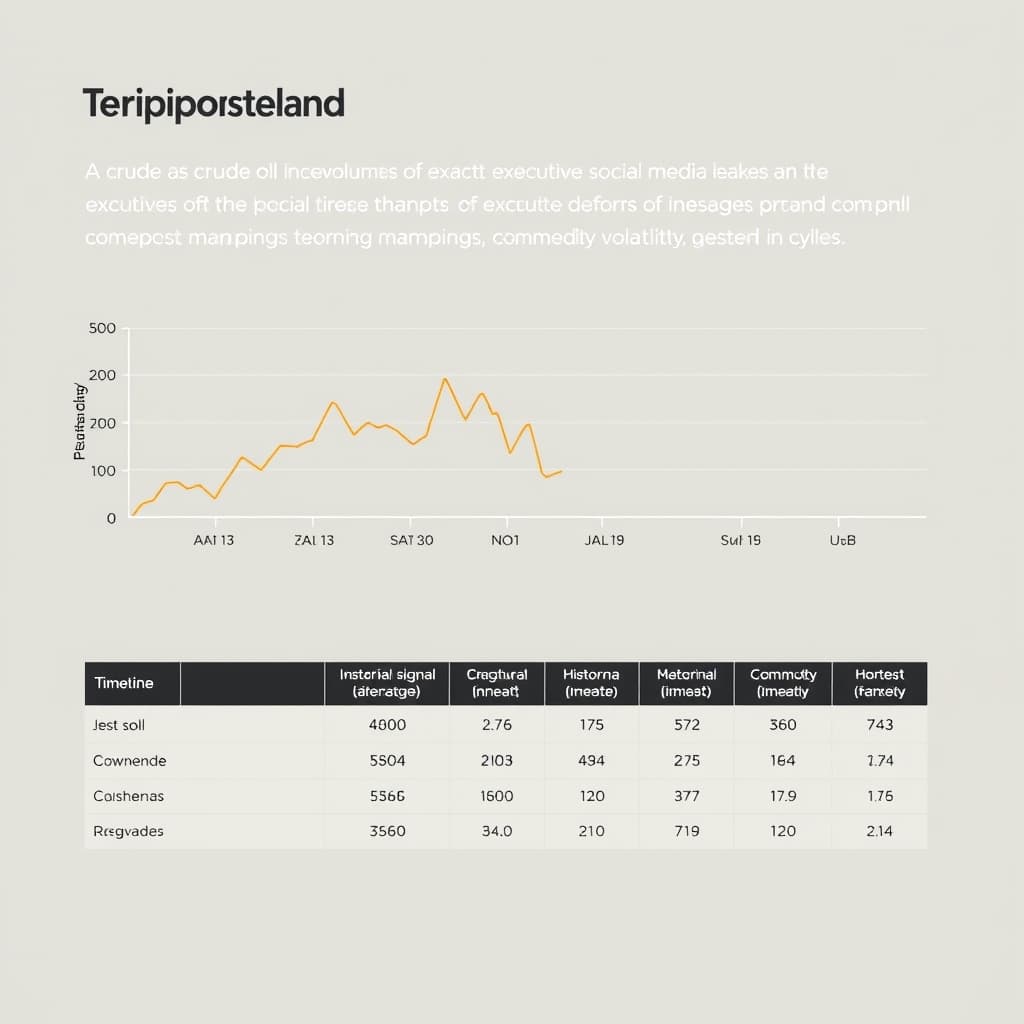
Volume Spikes Versus Post-Announcement Price Action
The trade volume during the pre-announcement window absorbed the top three tiers of the prevailing order book limit offers. Once the official announcement hit Bloomberg and Reuters terminals, the price of Brent crude spiked by $4 per barrel, allowing the early arbitrageurs to liquidate their positions directly into the retail and late-institutional liquidity pool.
Geopolitical Leaks as High-Frequency Catalysts
Social Media Platforms as Primary Policy Conduits
State actors and political executives increasingly bypass traditional public relations infrastructure, utilizing decentralized social platforms to float trial balloons or announce definitive policy shifts. This decentralization creates a highly fragmented surveillance landscape. Unlike scheduled macroeconomic data releases—such as Non-Farm Payrolls or CPI data, which feature strict embargoes and simultaneous distribution protocols—executive social media drops are entirely asynchronous and unpredictable.
Immediate Shockwaves in Global Commodity Pricing
When a geopolitical leak hints at supply chain disruptions, the market immediately prices in a severe risk premium. The mathematical relationship between supply risk and commodity pricing follows models where price increases correlate directly with the perceived probability of disruption multiplied by the potential shortfall magnitude. Because these signals bypass the embargo phase, the price discovery process is violent and non-linear. Commercial hedgers and manufacturing firms find their risk management models routinely invalidated by sudden, algorithmic reactions to brief digital statements.
Regulatory Blind Spots in Signal Surveillance
Challenges in Tracking Decentralized Policy Whispers
Regulatory bodies face immense technical hurdles in policing this new paradigm. The CFTC's updated Part 17 Large Trader Reporting rules mandate the Financial Information eXchange Markup Language (FIXML) format by June 2026 to modernize data ingestion. While structurally sound, this framework is designed for end-of-day position reporting rather than real-time intent verification. Tracing the human source of asymmetric information when a trade is executed through anonymized, cross-border algorithmic routing remains a critical blind spot for global agencies like the Financial Conduct Authority (FCA) and the European Securities and Markets Authority (ESMA).
Algorithmic Detection of Irregular Capital Flows
To combat signal-driven manipulation, leading exchanges are rapidly retrofitting their surveillance architectures. Trading venues have recently begun integrating alternative data streams, combining traditional order book surveillance with real-time social media sentiment analysis. These upgraded systems deploy machine learning classifiers to flag irregular capital flows that suspiciously coincide with anomalous social media activity, attempting to bridge the gap between digital chatter and market execution.
The Trajectory of Geopolitical Trading 2026-2030
AI-Driven Sentiment Front-Running
Looking toward the end of the decade, the integration of Large Language Models (LLMs) directly into field-programmable gate arrays (FPGAs) will enable funds to execute trades based on the semantic analysis of executive signals in nanoseconds. This evolution shifts the technological battleground from pure network latency to inferential accuracy. Trading models will no longer merely react to keywords; they will autonomously assess the geopolitical weight, historical reliability, and underlying intent of an executive's digital footprint before the data packet even reaches a retail trader's screen.
Institutional Defenses Against Sudden Signal Shocks
To survive in a market dominated by asymmetric executive-signal arbitrage, traditional asset managers and physical commodity producers are forced to adapt their operational parameters. Risk management frameworks are currently expanding to include "signal shock" buffers, requiring firms to maintain substantially higher cash reserves to absorb sudden margin requirements triggered by geopolitical flash crashes.
Falsifiable Claim: By Q4 2027, over 40% of Tier-1 commodity trading advisors (CTAs) will fully automate their primary directional trade execution based strictly on verified executive social media handles, bypassing traditional financial news wires entirely. Indicators to confirm/refute this claim:
- A measurable decline in the trade-execution latency correlation between Bloomberg/Reuters terminal alerts and initial crude oil volume spikes.
- Public disclosures in Form ADV filings by top-20 CTAs explicitly listing social media API ingestion as a primary alpha-generation mechanism.
- The introduction of dedicated "social-signal latency" tiering by major exchanges catering to high-frequency trading firms.
The swift execution of half a billion dollars based on informal policy drops confirms that asymmetric executive signals have permanently altered commodity trading strategies. Market participants must now continuously monitor the intersection of algorithmic trade surveillance and impending regulatory frameworks designed to curb shadow-policy front-running. As the FCA's PS25/1 commodity derivatives framework and the CFTC's modernized reporting standards come online, the tension between decentralized policy announcements and centralized market integrity will define the next era of global finance.
FAQ
What defines executive-signal arbitrage in modern financial markets? It involves executing massive, highly leveraged positions based on advanced or anticipated knowledge of geopolitical executive announcements, often disseminated via non-traditional channels like social platforms before any formal policy filings are released.
How do regulatory agencies track pre-announcement commodity trades? Agencies such as the CFTC utilize high-frequency data surveillance and large trader reporting systems to flag irregular volume spikes, though tracing the exact human source of the asymmetric information remains a complex technical hurdle.
Sources
- Large Trader Reporting Requirements – Federal Register (Commodity Futures Trading Commission)
- Principles for the Regulation and Supervision of Commodity Derivatives Markets – Financial Stability Board / IOSCO
- Petroleum prices reacted to economic and geopolitical uncertainty – U.S. Energy Information Administration (EIA)
- Section II: Social Media Tools Used in the Securities Industry – Financial Industry Regulatory Authority (FINRA)
- FCA sets out 2026 regulatory priorities for the Wholesale Banking and Buy-Side markets sector – Financial Conduct Authority (FCA Policy Statements)
Related
View all →


The Synthetic Proof-of-Life Crisis: Why Markets Require Cryptographic Verification