
From Experimental Scripts to Enterprise Stack: The Era of Quantum Software Engineering
The human brain struggles to visualize anything beyond four dimensions, yet we currently ask quantum developers to manually optimize circuits in Hilbert spaces that scale exponentially with every added qubit. The "100-qubit barrier" isn't just a hardware fidelity issue; it is a cognitive ceiling. Once a circuit exceeds a few dozen qubits, manual gate placement becomes indistinguishable from writing assembly code for a processor with an undocumented instruction set.
H.gate(0) to functional intent. This analysis dissects the architectural trade-offs of this shift, evaluating whether automated synthesis can genuinely bridge the gap between noisy hardware and enterprise logic.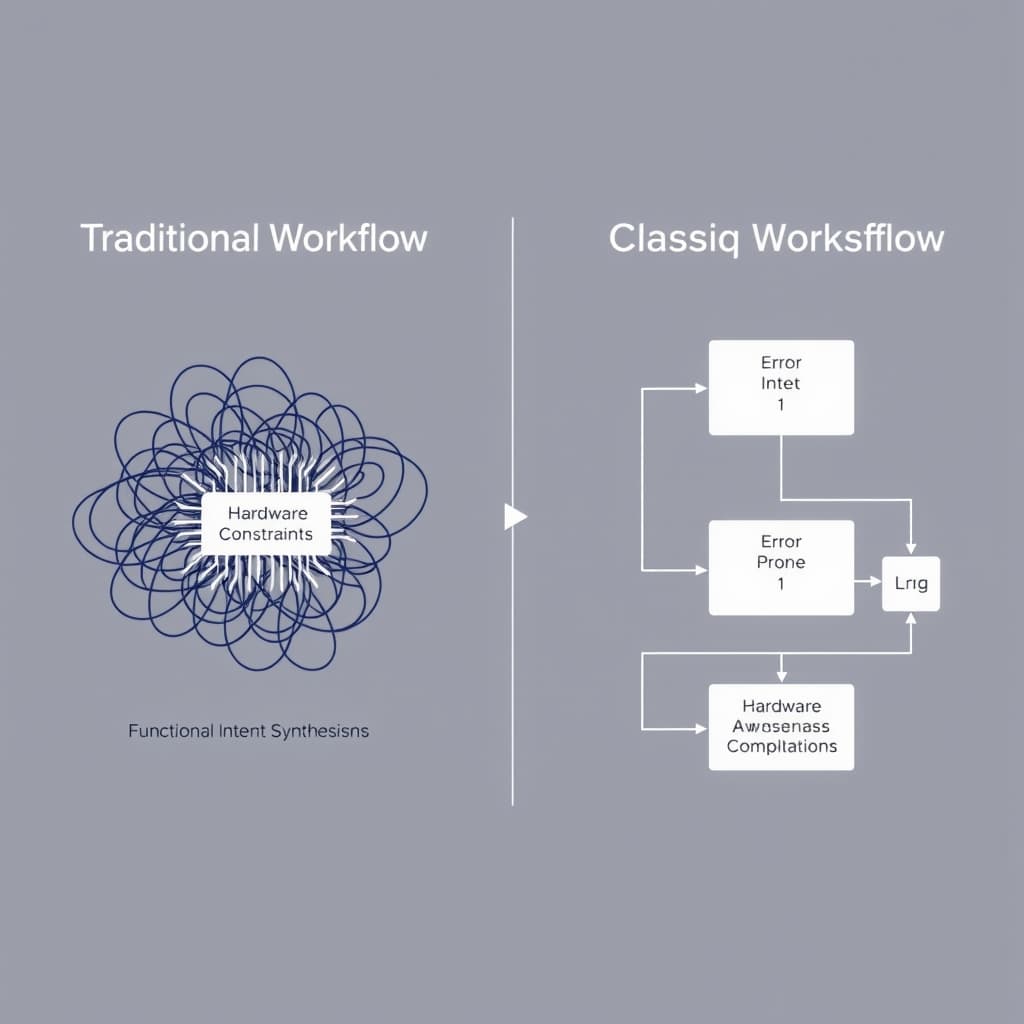
Escaping the Gate-Level Grind: Functional Synthesis
The dominant paradigm in quantum development—exemplified by Qiskit, Cirq, and PennyLane—is imperative. You tell the machine how to do something: "Apply a Hadamard gate to qubit 0, then a CNOT between 0 and 1." This works for academic experiments but fails at the enterprise scale. Classiq changes the paradigm to declarative: you tell the machine what you want (e.g., "Grover's search on a 50-variable dataset with a circuit depth limit of 100").
Constraint Satisfaction as a Compiler
The core engine of Classiq is not a standard translator; it is a constraint satisfaction solver. In classical compilation, optimization is usually about register allocation and instruction scheduling. In quantum, the constraints are physical and unforgiving: coherence time (T1/T2), gate fidelity, and connectivity topology.
When a developer defines a functional model (e.g., a Quantum Fourier Transform), the synthesis engine explores the massive design space of possible circuits that implement that logic. It filters them against hardware constraints—such as the limited connectivity of a superconducting rig like IBM's Eagle or the all-to-all connectivity of a trapped-ion system like IonQ. This automates the "mapping" problem, which remains one of the most computationally expensive steps in the compilation stack.
Moving Beyond Manual Entanglement
The trade-off here is control versus scalability. Hardcore physicists often argue that manual optimization allows for "physics-aware" tricks that compilers miss. While true for 5-qubit experiments, this argument collapses at 50 qubits. The probability of a human optimizing a 1,000-gate circuit better than a solver sweeping millions of configurations is statistically negligible. Functional synthesis abstracts away the auxiliary qubit management and uncomputation steps (cleaning up "garbage" data to allow interference), which are arguably the largest sources of bugs in complex quantum algorithms.
Integrating QPUs into Standard DevOps Pipelines
For quantum computing to generate value, it must stop being a science experiment and start being a coprocessor. The Classiq platform is architected to treat Quantum Processing Units (QPUs) as accelerators, conceptually similar to how CUDA integrates GPUs.
The CI/CD Disconnect
Current quantum workflows are often isolated Jupyter notebooks. Moving this to production requires integration with CI/CD pipelines. The new stack allows for "Quantum DevOps," where circuit synthesis happens at runtime or build time based on the specific hardware available.
Bridging the Talent Gap
The industry faces a severe bottleneck: there are fewer than a few thousand people globally who understand quantum mechanics deeply enough to write efficient gate-level code. By abstracting the physics into functional blocks (arithmetic, chemistry, finance), platforms like Classiq allow standard Python developers to invoke quantum subroutines without knowing the Hamiltonian of the underlying system. This decoupling is risky—it allows developers to write code that looks correct but is physically unrunnable due to noise—but it is the only path to scaling the workforce.
The Abstraction Gap: Classiq vs. Imperative SDKs
The friction between imperative SDKs (Qiskit) and functional platforms (Classiq) is the defining architectural battle of the mid-2020s. Imperative frameworks offer transparency; functional frameworks offer velocity.
Why Imperative Frameworks Hit Walls
Qiskit is excellent for learning and hardware characterization. However, building a modular arithmetic logic unit (ALU) in Qiskit requires manually managing carry bits and qubit routing. If the hardware topology changes (e.g., a qubit dies on the processor), the code often breaks or becomes suboptimal.
Classiq’s synthesis engine treats the circuit as a graph optimization problem. It can re-synthesize the entire algorithm in seconds to route around a dead qubit or adapt to a new topology. Benchmarks suggest that automated synthesis can reduce circuit depth by 20-50% compared to standard transpilation passes in Qiskit, primarily because the synthesis engine understands the intent of the block, not just the gate sequence.
Benchmarking Optimization
The critical metric is not just gate count, but "effective volume"—the successful run probability.
- Traditional Transpiler: Takes a generic circuit and tries to map it to hardware, adding SWAP gates to bridge unconnected qubits.
- Synthesis Engine: Generates the circuit from scratch knowing the hardware topology, often eliminating the need for SWAP gates entirely by choosing a different mathematical decomposition of the algorithm.
The Road to 2030: Decoupling Software from Hardware
If we look at the trajectory of the semiconductor industry, software eventually decoupled entirely from hardware specifics. We are not there yet with quantum, but we are entering the "Device Driver" era.
Hardware-Agnostic Compilation
The holy grail is "write once, run anywhere." Currently, a circuit optimized for a superconducting processor (fast gates, short coherence) performs terribly on a trapped-ion processor (slow gates, long coherence). Classiq’s approach creates an intermediate representation (IR) that captures the logical flow. The compiler then acts as the translation layer. This is essential for future-proofing: code written today for a 127-qubit machine must be re-compilable for a 1,000-qubit machine in 2028 without a rewrite.
The Risk of Premature Abstraction
There is a danger in abstracting too early. If the abstraction layer hides the noise characteristics too aggressively, developers may build algorithms that require logical error rates of $10^-10$ while the hardware is stuck at $10^-3$. The platform must remain "noise-aware," exposing leakage and crosstalk metrics to the developer, or the software will be theoretically perfect but practically useless.
Falsifiable Claim & Indicators
Claim: By 2028, over 80% of enterprise quantum applications will be generated via functional synthesis or high-level model compilers, rendering manual gate-level coding (Qiskit/Cirq) a niche activity reserved for hardware calibration and benchmarking.
Indicators to Watch:- Shift in Job Descriptions: A decline in requirements for "Quantum Physics" PhDs in favor of "Quantum Algorithm Engineers" with strong classical software backgrounds.
- SDK Evolution: Major SDKs (IBM, Google) introducing their own functional synthesis layers to compete with Classiq, effectively deprecating direct gate access for high-level users.
- Library Dominance: The emergence of "Standard Template Libraries" for quantum, where users import
QuantumFinanceorQuantumChemistrymodules rather than building circuits.
What Would Change My Mind
I would reconsider the inevitability of functional synthesis if hardware error correction (QEC) stalls significantly. If we remain in the Noisy Intermediate-Scale Quantum (NISQ) era for another decade, the overhead introduced by automated synthesis might be too costly. In a high-noise environment, "hand-crafted" circuits often squeeze out the last drop of fidelity that a compiler might sacrifice for generality. If error rates don't drop below the threshold where compiler inefficiencies are negligible, the "assembly language" approach will remain the only viable way to get results.
The Industrialization of Quantum Code
Classiq Version 1.0 is not merely a tool update; it is a signal that the quantum industry is graduating from the laboratory. By introducing high-level functional modeling and automated synthesis, it addresses the two biggest risks to quantum adoption: the scarcity of quantum talent and the complexity of hardware constraints. While the abstraction gap remains a challenge, the move toward treating quantum circuits as synthesized software artifacts rather than hand-wired physics experiments is irreversible. The future belongs to those who can code the logic, not just those who understand the spin.
Sources
Related
View all →